


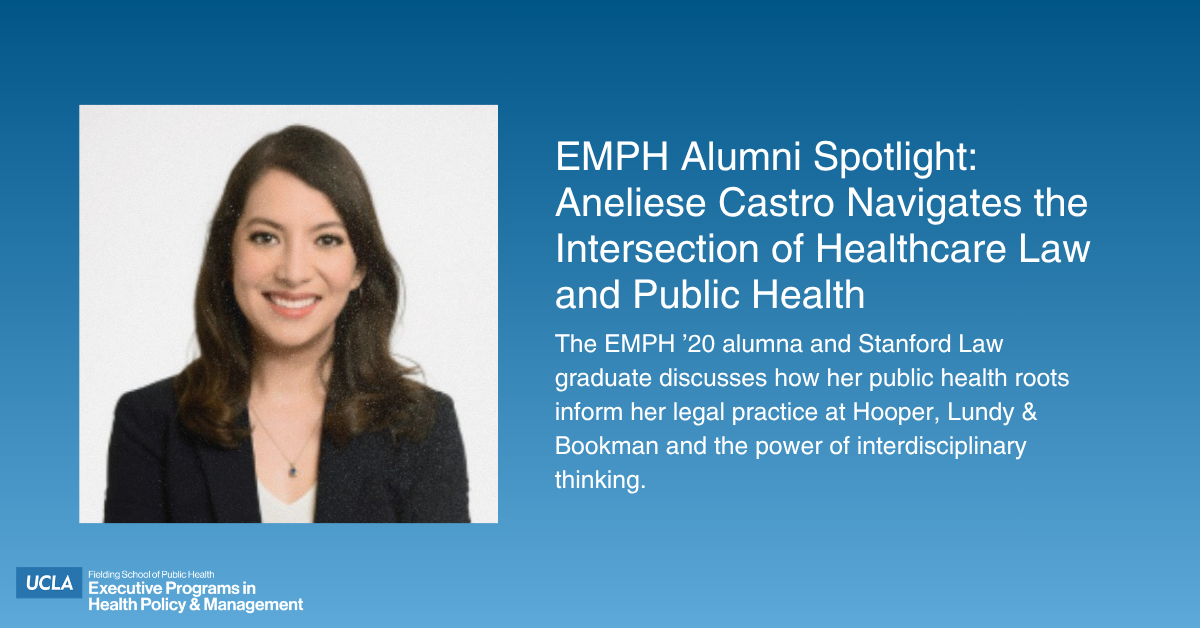
03 Apr EMPH Alumni Spotlight: Aneliese Castro Navigates the Intersection of Healthcare Law and Public Health
For Aneliese Castro, JD, MPH (EMPH ’20), healthcare isn’t just a matter of statutes and regulations—it’s about the people those laws serve. Currently an Associate at Hooper, Lundy & Bookman, P.C., Aneliese has built a career at the high-stakes intersection of health policy, advocacy, and law. Her journey from winning the EMPH Sinaiko Business Plan Competition to earning her JD at Stanford Law School exemplifies the “interdisciplinary edge” that the Executive MPH program provides. As a dedicated mentor to current student teams, Aneliese continues to bridge the gap between classroom theory and real-world impact.
In this spotlight, she reflects on the lessons she learned at the UCLA Fielding School of Public Health and why staying curious is the key to navigating the complexities of the modern healthcare landscape.
How does your MPH background inform your legal practice as an Associate at a premier healthcare law firm?
“My MPH has significantly shaped how I approach my work day to day. It allows me to appreciate how policy decisions, regulation, and financing sources in healthcare affect providers and patients in real, practical ways. That perspective is incredibly helpful in my legal practice, especially when advising healthcare organizations that are trying to stay compliant while still delivering quality care. It helps me bridge the gap between what the law requires and how healthcare actually works on the ground.”
Looking back at your Sinaiko Business Plan win, what was the most valuable lesson you took from that experience into your legal career?
“The biggest takeaway for me was the value of thinking across disciplines. The Sinaiko competition pushed us to consider legal, financial, operational, and equity issues all at once, which mirrors the kinds of challenges I see in healthcare law now. It reinforced that the strongest solutions aren’t purely legal, they’re practical, sustainable, and informed by the broader context in which organizations operate.
It also helped hone my ability to parse through the weeds of a large project to get to the most efficient path forward (though I really have Natalie to thank for that skill). Whenever I get too bogged down by the details of a project, I think about what item is the highest yield as a way to triage what needs to get done next.”
You and Natalie Yragui have been incredible mentors to our current students this year. Thank you! What was the most rewarding part of working with the student teams, SafeBite (EMPH Students Emily Brown, Maite Medina, RN, and Trishna Singh) and AccessLink Health (EMPH Students Marina Martinez, Maya Camacho, and D’Artagnan DeBow, MD, MBA)?
“Working with SafeBite and AccessLink Health was incredibly energizing. The most rewarding part was watching the students gain confidence as they refined their ideas and learned how to navigate real‑world constraints without losing sight of their mission. Both teams were tackling meaningful access and safety issues, and it was exciting to help them think through feasibility, policy considerations, and impact. Their creativity and commitment were a great reminder of why mentorship matters so much.”
What is your advice for students interested in the intersection of health policy, advocacy, and law?
“My biggest advice is to stay curious and open to interdisciplinary learning. Some of the most impactful work at this intersection happens when you understand not just the law, but also public health, economics, and the lived experiences of patients and providers. I’d also encourage students to seek out hands‑on opportunities including but not limited to clinics, fellowships, policy roles that expose them to how systems actually function. And finally, don’t be afraid to ask for guidance. Mentors can help you see paths you didn’t even know existed.”
Anything else you’d like to share?
“I feel fortunate to work in a field that aligns so closely with my values. Healthcare law ultimately comes down to people – our patients, providers, and communities. and that’s what keeps the work meaningful for me. I’m grateful for opportunities to mentor students and learn from them in return, and I’m excited to keep supporting the next generation of professionals working at the intersection of health, policy, and law.”