
08 Oct Summer 2026 MHA Capstone: Inside PSC Health’s First-Place Hospital Management Strategy
This year, the UCLA Fielding School of Public Health debuted a new approach to its Master of Healthcare Administration (MHA) capstone project. Students were challenged to compete in “Healthcare Hero,” an immersive hospital management simulation.
Over the course of the quarter, teams of students assumed executive leadership roles to run competing fictional hospitals. The simulation spans eight quarters (two business years) of operations, challenging teams to navigate market shifts, economic downturns, and healthcare crises. Each of the eight live rounds requires analysis, decision-making, and decision submission via the simulation portal, considering strategy, pricing, quality, capacity, finance, and human resources. Designed to mirror the real-world volatility of the healthcare sector, this simulation serves as the ultimate MHA capstone because it brings classroom theory into high-level, systems-wide strategic execution.
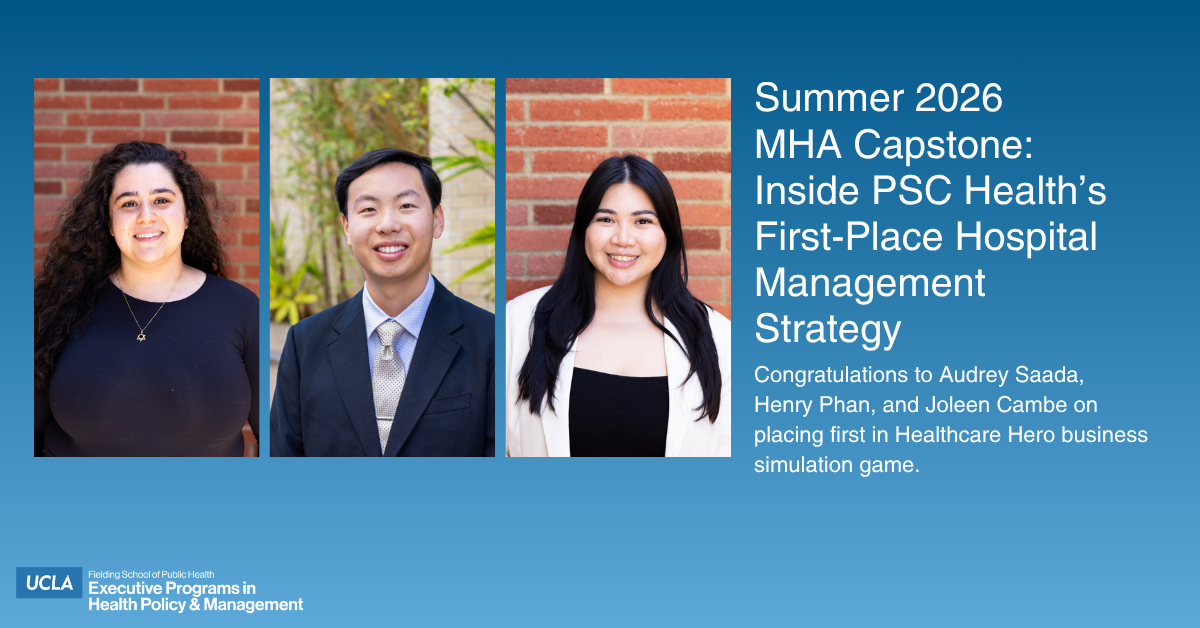
We caught up with the winning team from Summer Quarter 2026 to learn more about their experience. First-place MHA students Audrey Saada, Henry Phan, and Joleen Cambe joined together to form PSC Health as CEO, CFO, and COO, respectively.
Describe your healthcare facility.
Our hospital was named PSC Health after our last names Phan, Saada, and Cambe. But more importantly, PSC stands for our mission: Patient Success Counts. For us, that meant measuring success by more than the bottom line. We looked at the patients we served, the people we employed, and the quality of care we delivered.
By the end of the two years, we had grown, hired new employees, earned international certifications, and brought our ICU infection rate down. We also finished with the highest share price in the market.
Your team brought a mix of expertise to the table. How did you blend these distinct perspectives to build the winning strategy for your healthcare facility?
Each of us had a clear lane. Audrey, as CEO, focused on keeping our decisions aligned with our strategy, especially when the market or labor situations shifted on us. Henry, as CFO, kept a close eye on what every investment would cost us and how we’d fund it. Joleen, as COO, tracked market share, competitor pricing, and costs, and made sure our resources went where patient demand was strongest.
We believe that it wasn’t necessarily a matter of expertise that resulted in a winning strategy. What truly made it work was that we weren’t afraid to challenge each other. The big decisions were always made together.
What was the most challenging event, and how did your team pivot?
Honestly, the biggest challenge was one we saw coming but misread the unexpected events. Our hospitalization market share dropped while our closest competitor climbed, and that one miss accounted for most of our deficit that quarter.
The miss taught us that having capacity in the wrong service line doesn’t help your patients. After that, we focused on matching capacity and staffing to what patients actually needed in real time, not just what the forecasts said.
What was your biggest takeaway about hospital management?
Our biggest takeaway was that successful hospital management comes down to communication. Behind every decision about beds, staffing, or pricing was a conversation, and the best decisions came when we truly listened to each other. We spent countless hours on FaceTime and Zoom working through the simulation, and along the way we got to know each other both professionally and personally. That made all the difference. Once you understand how your teammates think, what they care about, and what they bring to the table, collaboration becomes easy. You can challenge each other’s ideas openly, disagree without it becoming personal, and reach decisions faster because there’s already a foundation of trust. It showed us that in healthcare leadership, strong relationships within the team are just as important as the numbers.
How will you take these insights into your current and future roles?
Audrey Saada: As a healthcare construction project manager, I initially thought my role would not relate to a CEO role or this simulation in any way, shape or form. However, I could not have been more wrong! Both roles require the same level of decisive leadership and problem-solving skills. Ultimately, managing complex healthcare projects and maintaining strategic alignment of a healthcare facility both demand strategic resource allocation, strict regulatory compliance and the ability to guide stakeholders or teams to remain focused on the same patient-centered missions and goals.
My greatest takeaway from this simulation is that financial success should be the byproduct of creating value, rather than the sole objective. As cliche as it may sound, despite the pressure to perform well on a metric level, I realized how much more transparent our decisions and discussions became when we felt comfortable pushing back on each other to meet the needs of PSC’s community rather than just meeting profit or market share goals or chasing the grade.
Joleen Cambe: As a nurse manager, I joined the MHA program because I wanted to take what I’ve learned from the bedside and strengthen it with leadership and administrative skills. The Healthcare Hero simulation helped me see how closely those areas are connected. In my current role, I’m often focused on the day-to-day needs of my staff and patients, but this experience pushed me to think more broadly about how staffing, capacity, quality, and financial decisions affect the organization as a whole.
One of my biggest takeaways is that staffing and capacity decisions need to be based on actual patient demand and continuously reassessed as conditions change. Having more staff or beds does not automatically mean better outcomes if those resources are not aligned with where patients actually need them. Going forward, I’ll be more intentional about looking beyond the immediate operational need and considering the larger organizational impact of those decisions.
The simulation also reinforced for me that good leadership requires communication and listening. When you understand the people you work with, both professionally and personally, it becomes much easier to have difficult conversations, challenge assumptions, and make decisions together. I hope to carry that perspective into future leadership roles as I continue growing from a bedside nurse manager into a more systems-focused healthcare leader.
Henry Phan: I learned a lot about trade-offs and the power of early investment to build long-term success, especially how much the long-term cost of a decision matters. As a program manager, I’ll carry that mindset into my work by looking beyond the immediate impact of a decision and asking how it will affect our patients, staff, and finances years down the road. The simulation also showed me that investing intentionally in quality and people is what makes an organization financially stronger over time.
Anything else you’d like to share?
We would like to thank William “Jasper” Blackman for always fueling our competitive fire.