


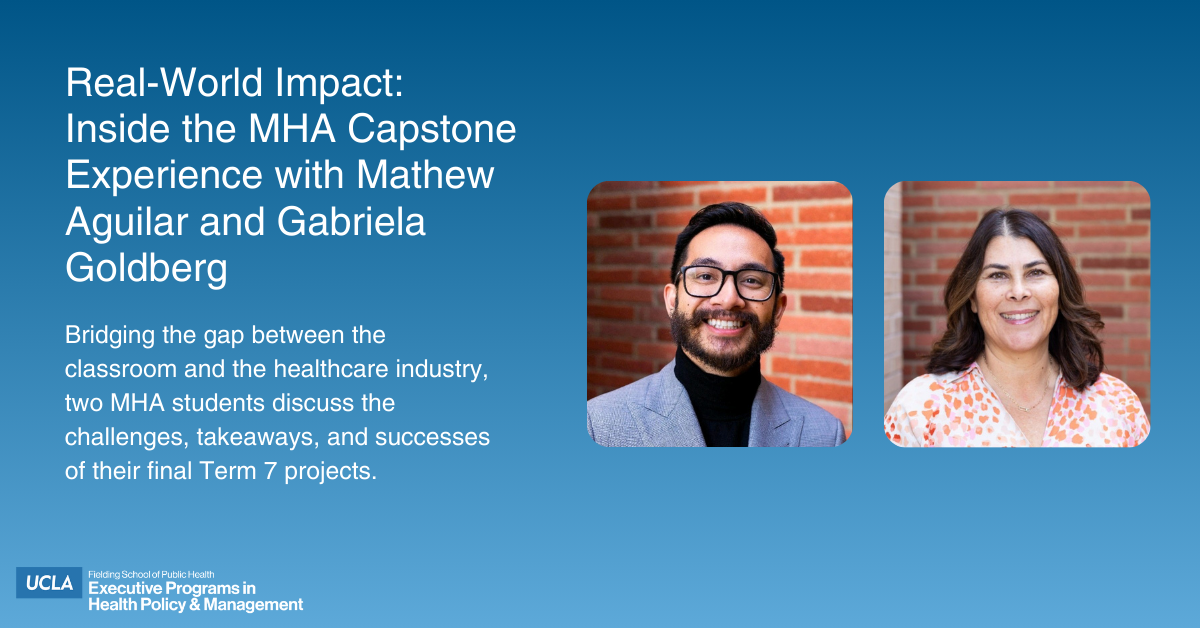
30 Sep Inside the MHA Capstone Experience with Mathew Aguilar and Gabriela Goldberg
One of the hallmarks of the UCLA Online MHA Program is the capstone project which students complete during Term 7 of the program. In this applied field project led by MHA Program Director Dr. Laura Erskine, the assignment is to design and conduct a project based on a health administration problem addressing the delivery, financing, and evaluation of healthcare administration services. Students prepare a consulting report and presentation for a letter grade.
We caught up with Mathew Aguilar and Gabriela Goldberg, who just completed the coursework for their MHA degrees on September 12th, marking Summer Quarter as their final quarters in the program, to learn more about their capstone experience.
Tell us about your capstone project.
Mathew Aguilar: I partnered with Ventura County Public Health’s Communicable Disease Division as a project intern. My capstone focused on creating a countywide measles preparedness and outbreak response protocol. This included developing workflows, CalCONNECT guidance, clinical tools, and communication templates to help strengthen coordination between public health, healthcare providers, and community partners.
Gabriela Goldberg: My capstone project focused on designing a Peer Litigation Support Program and education to provide emotional support for physicians involved in malpractice litigation. This work gave me insight into the breadth and complexity of creating a program that requires collaboration across multiple departments, including risk management, physician wellness, and leadership. A major lesson I learned was the importance of time management in balancing research, stakeholder input, and deliverables. I also enjoyed gathering data and analyzing results, especially when I could present findings using data visualization learned in prior coursework to highlight key patterns.
What is a key takeaway you have about the experience?
Mathew Aguilar: Public health is an essential part of healthcare. It may not be the most glamorous, but it is absolutely a calling. I was inspired by the passion and knowledge of everyone I worked with at Ventura County Public Health, and I hope to carry that same commitment forward in my career.
Gabriela Goldberg: A key takeaway from this experience is that successful programs require both vision and practicality. I also recognized the value of gaining stakeholder buy-in early, as their perspectives added credibility and strengthened the design.
Any advice for MHA students who will be working on their capstone in the next few quarters?
Mathew Aguilar: 1) Start early if you can. I formally began my project a couple of months before the capstone quarter started, but in reality, I had been setting things up almost half a year in advance. That extra time gave me space to adjust when the work picked up, and I cannot imagine trying to build everything from scratch once the quarter began. Even with that head start, I still found myself working right up to the final week of deliverables.
2) Be very clear about your project goals. I thought I had narrowed mine down, and even then, the amount of work I needed to cover quickly became broader and more complicated than expected. If my scope had been any bigger, it would have been unmanageable. It is better to have a specific and focused goal that you can expand on, rather than something too ambitious that you struggle to finish.
3) Take notes or journal throughout the process. Do not just record the big milestones but also write down the small details and your day-to-day thoughts. Things like what you worked on, how you felt about a particular challenge, or even a random idea you had in the middle of the day. Those little notes can be incredibly valuable later. Some of my best insights for the consultation report came from small and almost insignificant things I experienced along the way, and I wish I had written down more of them instead of relying on memory.
Gabriela Goldberg: For future MHA students, my advice is to select a project that is manageable within a 10-week timeframe and begin planning before the capstone quarter. Line up stakeholders early, secure necessary data, and break the work into smaller, achievable steps. By accomplishing a lot of the legwork before the Capstone quarter began, I was not overwhelmed with the deliverables during the quarter. Above all, choose a topic you are passionate about—motivation makes the process more meaningful and the outcome more rewarding. Finally, I also welcomed input, critique, and guidance from Dr. Erskine, and I would encourage others not to be afraid of constructive feedback—it makes the final project stronger.
Anything else you’d like to share?
Mathew Aguilar: The ten weeks of the capstone somehow feel like both the longest stretch of the program and the fastest blur of deadlines. On one hand, the workload can feel heavy, and the days can drag. On the other hand, the weeks fly by, and the final deliverables arrive before you know it. The best thing you can do is trust your process, lean on your peers, and remind yourself that all the work you are doing has a real impact.
Thank you, Mathew Aguilar and Gabriela Goldberg, for sharing your UCLA MHA capstone experience!