


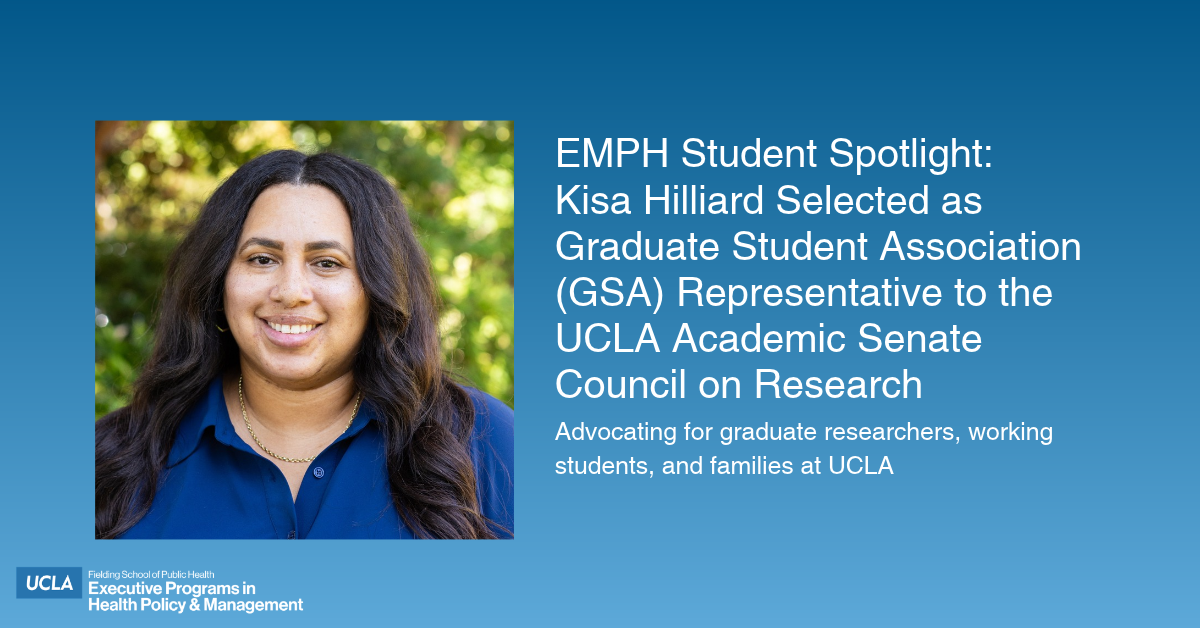
16 Nov EMPH Student Spotlight: Kisa Hilliard Selected as GSA Representative to the UCLA Academic Senate Council on Research
We are pleased to spotlight Kisa Hilliard, a second-year student in the Executive MPH program. Kisa was recently selected to serve as the Graduate Student Association (GSA) representative to the UCLA Academic Senate Council on Research (COR) for the 2026–2027 term. With extensive experience as a UCLA research center coordinator and a deep commitment to advocating for her peers, Kisa brings a unique and valuable perspective to the role. We sat down with her to discuss her new position and her priorities for the coming year.
For those unfamiliar with university governance, how would you explain what the UCLA Academic Senate and the Council on Research (COR) do?
UCLA runs on what’s called shared governance. The administration manages the university’s operations, and the faculty, through the Academic Senate, have a formal voice in decisions about the academic mission: teaching, research, and service. The Senate is organized into councils and committees, each focused on a specific area.
The Council on Research (COR) is the Senate’s voice on research. It advises on campus research policies and procedures, works mainly with the Office of the Vice Chancellor for Research, and meets monthly during the academic year. More broadly, COR is where questions about what UCLA research needs to thrive get raised and debated.
As the GSA graduate student representative, how would you describe your role and responsibilities on the Council?
My role is to make sure the graduate student perspective is in the room when research policy is discussed. Graduate students do much of the day-to-day work of research at UCLA and they are often the first to feel the effects of policy and funding changes. I attend COR meetings, review materials, and offer feedback from a grad student standpoint. My goal is to draw on my own experience while gathering input from fellow graduate students, so their concerns inform the Council’s conversations.
Why were you excited to take on this leadership position for the 2026–2027 year?
I come to this position from two sides. I’m a graduate student in the Executive MPH program, and I have over a decade’s worth of experience coordinating a UCLA research center. So I see research from the student desk and the administrative desk at the same time.
Over the years, I’ve watched many postdocs come and go, and I’ve also seen talented people turn down positions because they couldn’t sustain a life in Los Angeles on what we could offer. Add the funding instability of the past couple of years, and the path from graduate student to postdoc to faculty member feels more fragile than ever. Each step depends on the one before it. When we lose people at any stage, we lose future researchers, mentors, and discoveries. I was excited to take on this role because I want to be a voice in the room for the people at the start of that pipeline and to do what I can to help keep a research career at UCLA within reach.
Your term runs from September 29, 2026, through June 11, 2027. What are your specific goals or priorities you hope to accomplish on behalf of graduate students during your term?
First, I want to advocate for keeping childcare and family support at UCLA. Graduate students, postdocs, and early-career researchers are often in the years when they’re starting families, and they usually have the least salary and flexibility to manage it. Without reliable, affordable childcare, many have to choose between their careers and their families, and often the career loses. Some of UCLA’s most important research is done by people who are also raising children. Supporting them as whole people helps them do their best work, and it helps UCLA keep talented researchers it has worked hard to train.
Second, I want every kind of graduate researcher to be part of the conversation. When people talk about student research, they often picture PhD students in a lab, which is important, but master’s and professional students, part-time students, and those working full time while studying also contribute to UCLA’s research, whether as research assistants, center staff, or collaborators on community projects. Their needs and experiences can look different, and I want to make sure those differences are understood and considered when decisions are made about how research is supported.
How can fellow graduate students share their research concerns, ideas, or feedback with you throughout the year?
Please reach out. You can email me at kisashful@ucla.edu. I’m especially interested in concrete examples: how funding changes have affected your work, gaps in research support you’ve run into, or ideas for what would help. I’m unable to share the details of confidential Council deliberations, but I can promise to listen and to carry what you all tell me into those discussions.
Anything else you’d like to share?
Research has been part of my life for a long time, and I’m still learning, which is one of the things I love most about it. Taking on this role while working full time, being in grad school, and raising a young family is a stretch, but it feels worth it. To any grad student who wonders whether they have the time or experience to get involved: your perspective is needed, and it matters. You don’t have to be an expert to make a difference. Showing up and speaking honestly about your experience is enough.