


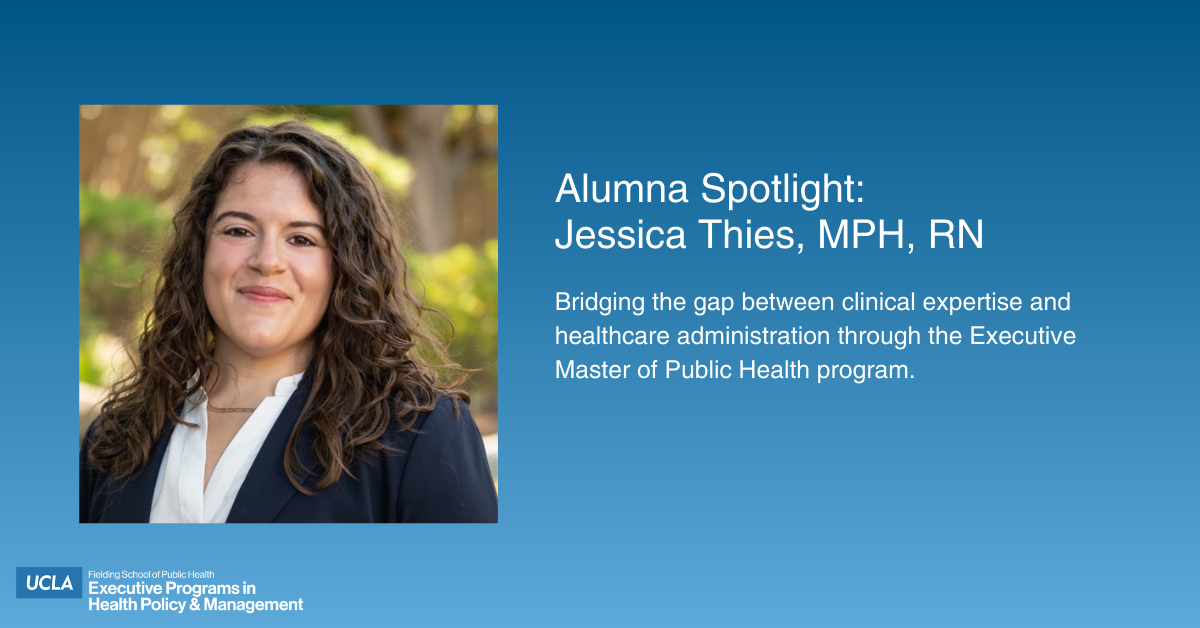
10 Mar Bridging Clinical Excellence and Leadership: A Conversation with Jess Thies, MPH, RN
At the intersection of clinical expertise and public health leadership, Registered Nurses (RNs) are uniquely positioned to drive healthcare innovation. However, many clinicians feel their career trajectory is limited to traditional bedside roles or advanced nursing degrees. Jessica Thies, MPH, RN, is a powerful example of how the UCLA Executive Master of Public Health (EMPH) program in Health Policy and Management can break those boundaries.
A 2022 graduate of the EMPH program, Jess has successfully transitioned from clinical practice to a pivotal leadership role as the Nurse Manager of City of Hope’s Mobile Cancer Prevention and Screening Program. By combining her nursing background with the strategic, administrative, and communication tools gained during her time in the program, she is now leading a “clinic on wheels” that brings life-saving screenings directly to the community.
We sat down with Jess to discuss her journey, the evolution of her role at City of Hope, and why she believes more nurses should take a seat at the administrative table.
Q: Tell us about your position as the Mobile Cancer Prevention and Screening Program Nurse Manager:
Jess: I had the incredible opportunity to participate in City of Hope’s Administrative Fellowship, where I worked on several projects related to the mobile screening program. By the end of the fellowship, I was involved in many aspects of the program.
Watching it evolve from a concept in Excel to a fully operational clinic, complete with a dedicated team and a mobile unit, has been an amazing experience. I’m not sure I’ll have another opportunity like this, but it’s been an unforgettable journey to help make a difference for patients in this way.
Q: What do you find most rewarding about this work?
Jess: The people are what make this experience so special—the patients and the incredible team I work with. I still get chills when I think about the first patient we saw. It’s such an honor and blessing to be part of this amazing initiative at an institution that recognized the need to serve the community. On top of that, I have the privilege of witnessing the dedication and passion that our team members bring to their work every day.
Being a pioneer is never easy, but the learning opportunities since the program launched have been invaluable, and those opportunities continue. It takes a truly unique group of individuals to embrace the unknowns and tackle them with determination, passion, and hope.
Q: How did the EMPH program prepare you for this transition?
Jess: One key takeaway I had from the pandemic was realizing that healthcare providers often struggle to communicate about healthcare with those outside of the clinical world. I entered the EMPH program with the goal of improving my communication skills, especially with people from diverse backgrounds and different work histories.
The program exceeded my expectations in that regard. The skills I developed there are ones I use every day, thanks to the valuable practice I got every other weekend, Friday and Saturday. Having the opportunity to engage with classmates, professors, and respected leaders in person was incredibly impactful and has made a lasting difference in my career.
Q: Why should other RNs consider the EMPH program?
Jess: I’m passionate about encouraging nurses to pursue nontraditional careers or degrees. It’s easy to feel boxed in, thinking that nurses are only meant to stick to roles tied directly to nursing or that they must pursue advanced nursing degrees. Personally, I believe healthcare would benefit greatly if more clinicians took on administrative roles.
It can be intimidating to dive into subjects like accounting when you have a Bachelor of Science in Nursing, but even though it felt like a steep learning curve at times, the cohort was incredibly supportive. No one was left behind, and everyone had a place. My nursing background proved to be an asset in many of the classes, allowing me to offer unique insights during discussions. The beauty of cohort learning is that you’re all learning from one another, and nursing brings an invaluable perspective to the table.
Take the Next Step in Your Nursing Career
Are you a Registered Nurse looking to expand your impact beyond the bedside? The EMPH program is designed for working professionals who want to lead the future of public health.
- Cohort-Based Learning: Join a supportive network of diverse professionals.
- Flexible Schedule: Designed for full-time clinicians and administrators.
- Practical Leadership: Gain the “hard skills” in finance, policy, and communication.