


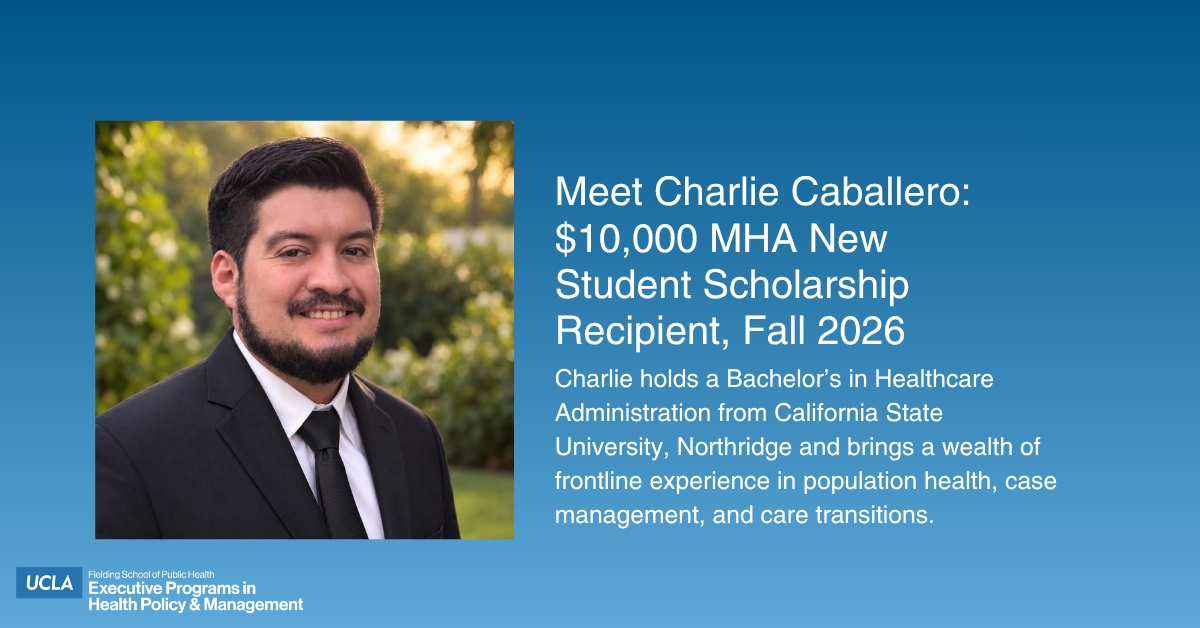
24 Sep Meet Charlie Caballero: $10,000 MHA New Student Scholarship Recipient, Fall 2026
The UCLA Fielding School of Public Health is thrilled to announce Charlie Caballero as a recipient of the $10,000 MHA New Student Scholarship for Fall 2026. An alumnus of LA Pierce College and CSUN (where he earned his B.S. in Healthcare Administration), Charlie brings a wealth of frontline experience in population health, case management, and care transitions. Currently serving as a Behavioral Health Care Coordinator at UCLA Health since February 2025—and previously a Care Transitions Coach at the Partners in Care Foundation—Charlie has dedicated his career to supporting vulnerable populations and older adults navigating complex health systems. At UCLA Fielding School, he looks forward to applying his real-time clinical operations background to his coursework, tackling cross-sector administrative challenges, and cultivating mentorship opportunities for future healthcare professionals.
We sat down with Charlie to discuss his reaction to receiving the award, his passion for care continuity, and his commitment to restoring dignity to the patient experience.
How did it feel to learn you had received this award, and what does this recognition and financial support from the UCLA Fielding community mean to you as you start this next chapter?
I felt elated and grateful that my journey and hard work was being recognized. This recognition and financial support provide me with greater opportunities to become involved in the UCLA community including participating in extracurricular activities, attending events, and resources offered to build my career and social network. I hope to use the opportunities for continued personal, professional, and academic growth while making a meaningful contribution to the UCLA Fielding community throughout my academic journey and beyond.
Your journey demonstrates dedication—from balancing work while earning your degrees at LA Pierce College and CSUN, to providing hands-on case management. What ultimately made this the right time to pursue your MHA and how has your path shaped your approach to your next steps in your journey?
Following completion of my undergraduate degree in Healthcare Administration at CSUN, the positions I held continued to shape my career by helping me connect theoretical principles with real-world healthcare experiences. Those connections developed gradually because of the limitations of certain roles and responsibilities. In my current position, however, the learning trajectory and connection between theory and practice have increased exponentially.
The path I have taken has given me the fundamentals I need to succeed in an MHA program. These include time management, project management, team collaboration, organization, and finding ways to improve repetitive processes while maintaining a high level of quality. Each position has contributed something different to my professional development, and those experiences ultimately helped me recognize that there was no better time than the present to begin planning for the future.
From your work as a Care Transitions Coach at Partners in Care Foundation to your current role as a Behavioral Health Care Coordinator at UCLA Health, you have been on the front lines supporting older adults, vulnerable populations, and patients with complex health care needs and mental health conditions. How have these frontline coordination experiences influenced your perspective on population health and care delivery?
My frontline coordination experiences have demonstrated that, regardless of the setting in which a healthcare worker operates, every member of the healthcare team plays a pivotal role in patient care.
A patient’s healthcare journey does not begin or end in one location. Patients may move between their homes, hospitals, skilled nursing and rehabilitation facilities, assisted living or board-and-care settings, hospice, and other levels of care. Each transition represents an opportunity to either strengthen or disrupt continuity of care.
My mission is to help ensure that patients receive the best possible care throughout that continuum, with an emphasis on safety, quality of life, and successful transitions to the next appropriate level of care.
Since February 2025, you’ve been serving patients directly within UCLA Health. As you launch your MHA studies at the UCLA Fielding School of Public Health this fall, how do you see your daily work in behavioral health intersecting with your coursework, and what specific systemic or administrative challenges in healthcare are you most passionate about addressing?
I will admit that balancing my professional workload with my educational responsibilities will be a challenge. However, I choose to embrace that challenge and want to apply the new skills I will be learning with those I’ve been developing over the past several years. Time management, organization, and establishing clear boundaries between my professional, academic, and personal responsibilities will be essential to navigating the MHA program successfully.
Throughout my healthcare career, I have encountered many systemic and administrative challenges. That complexity is part of what makes healthcare such a unique and intriguing industry to me. I believe there are opportunities for healthcare leaders and mentors to encourage professionals to think beyond traditional boundaries and foster greater collaboration across different sectors of healthcare.
In my work, I have encountered situations that intersect with areas such as accounting, fraud, waste and abuse, legal considerations, public policy, and social services. These experiences have shown me how interconnected healthcare truly is. One area I am particularly passionate about is developing and supporting strong healthcare leaders and operations professionals who are willing to mentor others, encourage curiosity, and create opportunities for the next generation of healthcare professionals to grow.
With a foundation in both community-based population health and hospital behavioral health, what is your ultimate career goal after completing your degree? What impact do you aspire to make as a healthcare leader?
I am still exploring what my ultimate career goal will be but, at a minimum, I hope to eventually serve in a management or supervisory role. I see tremendous potential for growth and continued learning within healthcare, and I want to remain open to where those opportunities may lead.
As a healthcare leader, I hope to inspire the next generation of healthcare professionals to give back to their communities, advocate for patients and families, and help return a sense of health, stability, and dignity to the people we serve. Ultimately, I want my work to help alleviate suffering and improve the experience of navigating healthcare, regardless of a person’s circumstances.