


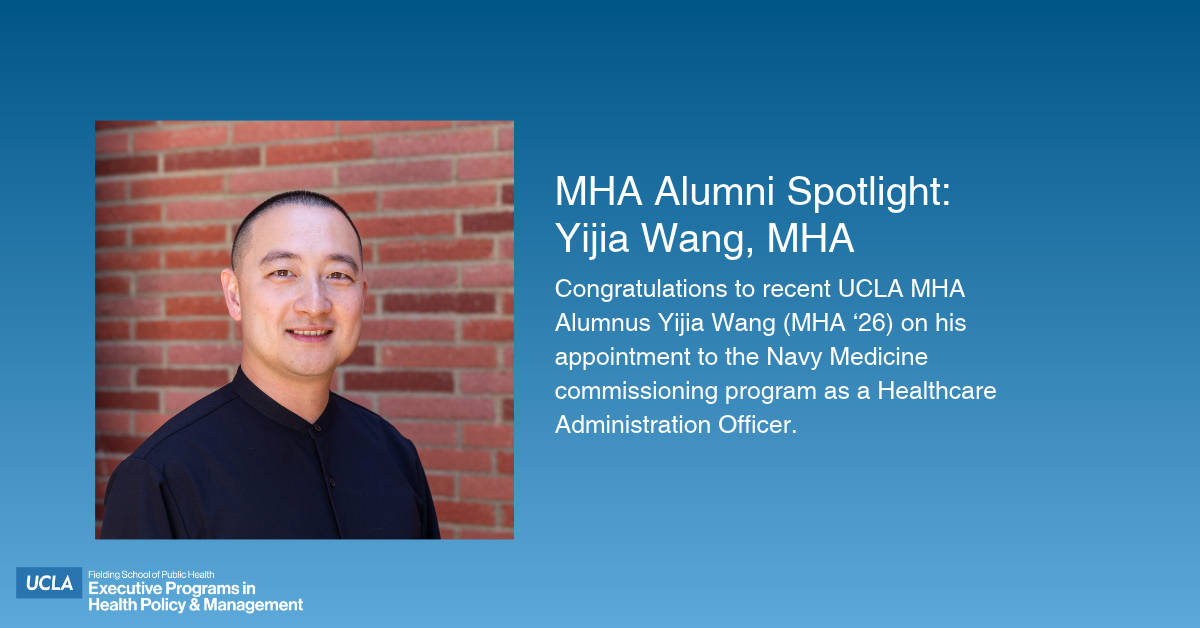
22 Oct MHA Alumni Spotlight: Yijia (James) Wang Earns Navy Medical Service Corps Commission – Healthcare Administration Officer
For recent UCLA Master of Healthcare Administration (MHA) graduate Yijia (James) Wang, earning his degree marked both an academic triumph and a pivotal turning point in his Naval service. Shortly after graduating in June 2026, James achieved a major career milestone: selection into the Navy Medicine Commissioning Program as a Healthcare Administration Officer in the Medical Service Corps. Transitioning from enlisted operational logistics to healthcare leadership, he is stepping into strategic oversight within the Defense Healthcare System—an enterprise serving more than nine million active-duty service members, retirees, and military families. In this alumni spotlight, James shares how balancing active duty, family, and graduate study prepared him to drive system-wide performance, how UCLA MHA faculty shaped his approach to complex healthcare challenges, and his vision for advancing medical readiness in Navy Medicine.
What does an election for the Navy Medicine commissioning program as a Healthcare Administration Officer mean to you at this pivotal stage in your Naval career?
Being selected for Navy Medical Service Corps is not simply about achieving a career goal but is about taking the opportunity to serve with greater purpose and make a lasting difference in the lives of those who serve our nation. The Navy Medicine commissioning program provides a unique opportunity to allow me to work directly with Defense Healthcare System, one of the largest healthcare systems in the nation, and serve over 9 million beneficiaries including active-duty service members, retirees and their families. I am grateful for this opportunity to transition from supporting fleet operational readiness through logistics to strengthening Naval medical readiness through healthcare leadership.
How did your prior service experience inspire you to step into healthcare leadership within the Medical Service Corps?
Throughout my Naval career, I have learned that logistic operations support our mission by supplying essential materials. However, mission readiness is not solely dependent on the advance technology or equipment. More importantly, our Navy’s strength is inextricably linked to the health and medical readiness of our Sailors, Marines, and their families. My belief of taking care of our service members means strengthening the healthcare system they rely on.
Commissioning is a significant professional evolution—how does this new role shift your day-to-day scope of leadership and service?
During my enlistment career, my leadership focused primarily on operational execution, resource management, and ensuring our Sailors have the tools and support necessary to accomplish their missions. As a Medical Service Officer, my responsibilities will expand into organizational strategy, healthcare policy, and system-wide performance improvement. What’s more, I will also have the opportunity to influence how healthcare systems are designed and how resources are prioritized.
How did the MHA curriculum prepare you for the operational and administrative complexities of military healthcare?
The UCLA Master of Healthcare Administration program fundamentally transformed how I approach organizational challenges, and healthcare delivery. While my background in finance and logistics provide a strong foundation in resource management, the MHA curriculum provide me with a broader understanding of the relationships among healthcare policy, financial sustainability and patient outcomes.
Were there specific courses, faculty, or real-world projects during your time in the program that directly shaped your readiness for the Medical Service Corps?
In healthcare accounting, Professor Galper helped me build upon my previous financial management experience. I developed a deeper appreciation for how healthcare finance works. In the Operations class, Dr. Potthoff emphasized the importance of understanding processes, identifying bottle neck and using data to improve organizational performance. Those skills also directly contributed to my success in the Capstone Project. The Strategy and Marketing course, taught by Dr. Vriesman and Dr. Elginer, challenged me to look beyond operational efficiency and consider how healthcare organizations develop long-term strategies, understand the needs of the populations we serve. The health policy coursework with Dr. Chu broadened my understanding of how policies are developed and provide direct insight for public service sector. Finally, the mentorship and guidance I received throughout my Capstone project from Dr. Erskine allowed me to bring all courses together to solve a real-world problem at Military Healthcare System. The faculty members and those learning experiences helped me develop collaborative leadership skills I hope to bring to Navy Medicine.
How did you balance your active military duties or service commitments while completing your graduate degree?
Balancing military duties, graduate education, and family responsibilities was one of the most challenging aspects of my journey. To be honest, there was no perfect balance. Most days required careful prioritization, discipline, and personal sacrifice. Most of my evenings and weekends were often dedicated to assignments and group projects. It required me to be intentional with my time and remain focused on the long-term career goal, Medical Service Commissioning program, that motivated me to pursue MHA degree.
What message or advice do you have for fellow service members or veterans considering an MHA degree to advance their military or post-service careers?
My advice to fellow service members and veterans is to never underestimate the value of the experience and leadership skills you have developed both inside and outside the military service. Many of those skills are highly transferable to healthcare administration. However, experience alone is not enough, pursuing an MHA provides an opportunity to broaden your perspective, challenge your existing ways of thinking, and develop further knowledge to navigate the complexities of healthcare organizations. I encourage future MHA students to approach graduate education with a clear purpose and remain curious. Most importantly, actively seeking opportunities to apply what you have learned to real-world challenges.