


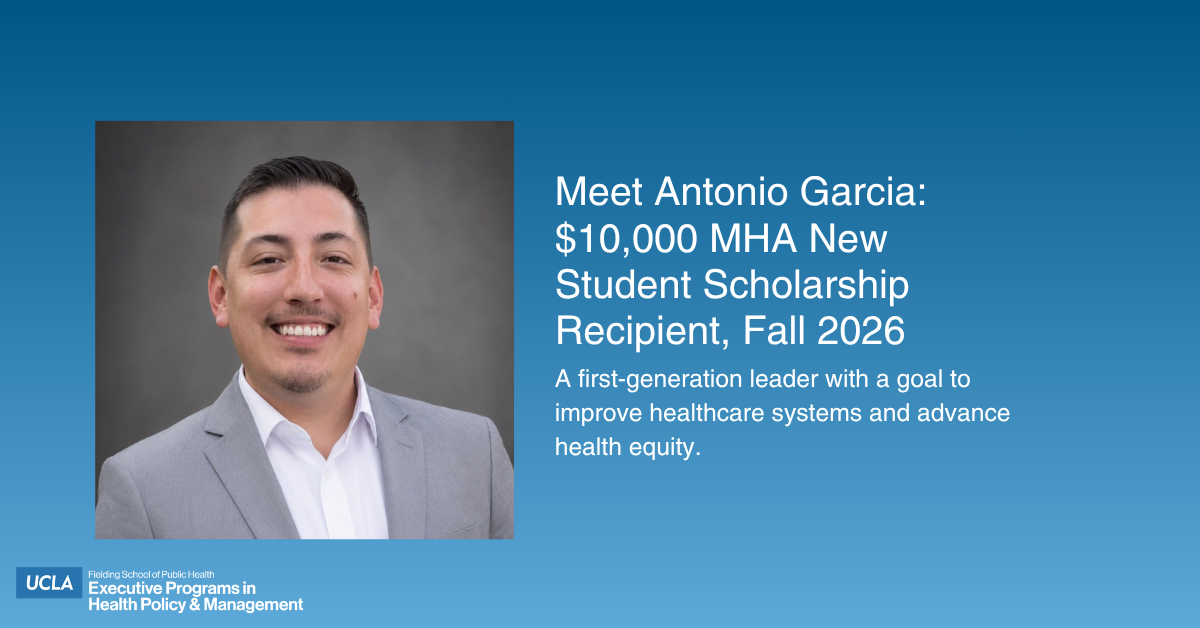
21 Sep Meet Antonio Garcia: $10,000 MHA New Student Scholarship Recipient, Fall 2026
The UCLA Fielding School of Public Health is thrilled to announce Antonio Garcia as a recipient of the $10,000 MHA New Student Scholarship for Fall 2026. A first-generation Mexican American scholar with a B.S. in Human Biology from UC San Diego, Antonio brings nearly a decade of impactful leadership in educational equity and data-driven community programming at City Year Los Angeles. Having managed large-scale interventions across Boyle Heights, South LA, and Koreatown, he is now bringing his deep-rooted commitment to community advocacy to the healthcare sector. At UCLA Fielding, Antonio plans to merge his background in biological sciences, organizational management, and equity work to optimize health systems and improve care access for historically underserved populations.
We sat down with Antonio to discuss his inspiring journey, what this scholarship recognition means to him, and his vision for the future of healthcare leadership.
How did it feel to learn you had received this award, and what does this recognition and financial support from the UCLA Fielding community mean to you as you start this next chapter?
Learning I had received this award was an incredibly meaningful and humbling moment. As a first-generation Mexican American student, reaching this point has been shaped not only by my own determination, but also by the sacrifices, encouragement, and opportunities that made it possible for me to pursue higher education. To have the UCLA Fielding community recognize my journey and invest in my future allows me to focus on my MHA journey, and on learning, growing, and contributing to the healthcare community. More than the financial assistance, this recognition reminds me that my experiences, perspective, and commitment to serving communities have value. I am deeply grateful for that investment, and I hope to honor it by using what I learn at UCLA to create a meaningful and lasting impact for the communities I serve and represent.
You hold a B.S. in Human Biology from UC San Diego and have spent nearly a decade in leadership at City Year Los Angeles—managing large teams, securing major contracts, and driving interventions for youth in Boyle Heights, South LA, and Koreatown. What inspired you to connect your background in science and community advocacy to a Master of Healthcare Administration at UCLA Fielding School of Public Health?
My journey to healthcare administration began with my B.S. in Human Biology at UC San Diego, where I developed an understanding of the inner workings of the human body, and volunteered with organizations like the Flying Samaritans, catapulting my interest in wanting deeper connections to the humanity behind the medical field. I became increasingly interested in the circumstances, communities, and systems that shape people’s access to quality healthcare. My over a decade-long experience advancing educational equity with the nonprofit City Year Los Angeles brought this realization into focus. Serving students, families, schools, and the communities of Boyle Heights and South Los Angeles, showed me that health and opportunity are deeply influenced by the systemic opportunities and barriers that surround individuals. Leading teams and programs has taught me how much impact can be created and limited by the way organizations are designed, managed, and resourced. Pursuing an MHA at UCLA Fielding is the natural merging of my science background, commitment to underserved populations and leadership experience. My goal is to translate the skills I have developed in education to improve healthcare systems and advance more equitable outcomes.
With a foundation in human biology, data-driven community leadership, and social-emotional advocacy across Los Angeles, what is your ultimate career goal after completing your MHA degree? What impact do you aspire to make as a healthcare leader?
My ultimate goal is to become a healthcare leader who improves the systems through which people access, experience, and benefit from care, particularly in communities that have historically faced barriers to opportunity and health. I aim to bring together my background in human biology, community leadership, and data-driven program management to lead healthcare organizations toward more equitable, effective, and patient-centered outcomes. Ultimately, I want my work to extend beyond addressing individual needs to improving the systems that shape those needs in the first place. Whether through healthcare operations, quality improvement, or population health, I aspire to build and lead programs that translate data and community insight into meaningful improvements in people’s lives.