


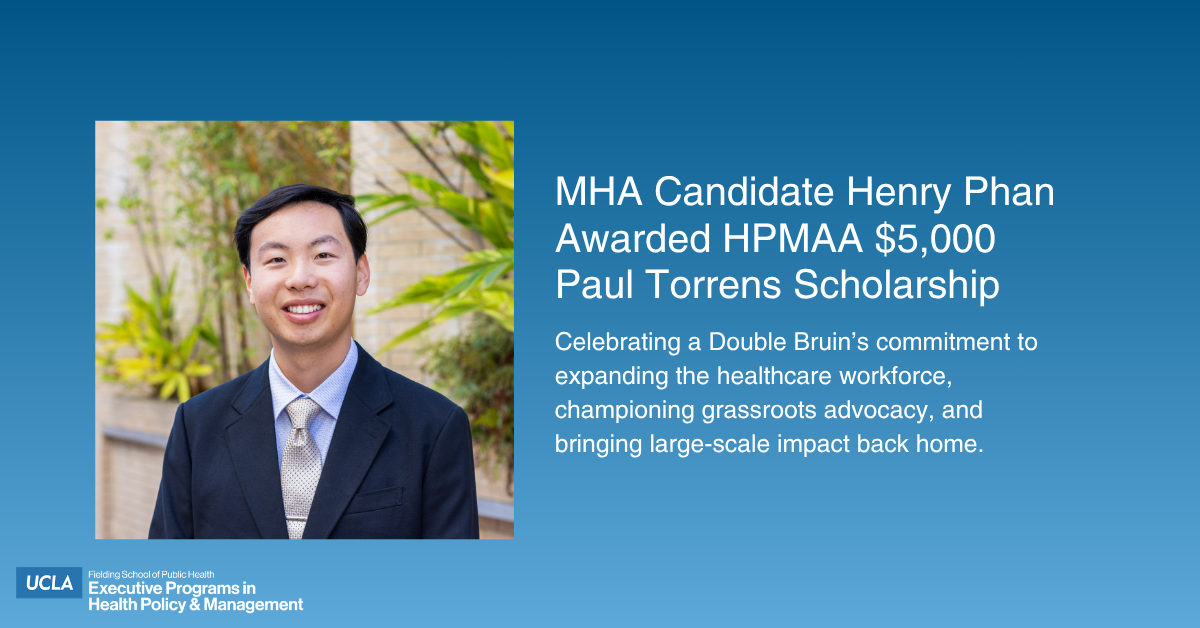
09 Jul MHA Candidate Henry Phan Awarded HPMAA $5,000 Paul Torrens Scholarship
The UCLA Fielding School of Public Health Master of Healthcare Administration (MHA) Program is proud to celebrate Henry Phan as a recipient of this year’s $5,000 Paul Torrens Scholarship. Sponsored annually by the Health Policy and Management Alumni Association (HPMAA), this prestigious award celebrates the legacy of Dr. Paul Torrens and his lifelong dedication to bridging the academic and practice worlds. Henry, a first-generation student and proud Double Bruin, beautifully embodies this mission. In addition to serving as the VP of Professional Development for the MHA Student Association (MHASA), Henry works full-time as a Program Manager at Providence St. Mary Medical Center and is the founder of the Healthy High Desert Initiative. By connecting the dots between health policy, workforce expansion, and local medical needs, Henry is actively working to dismantle the provider shortage in his hometown.
Below, Henry shares his insights on drawing inspiration from the Paul Torrens Health Forum, maximizing the unique hands-on opportunities of his on-campus immersions, and how the MHA curriculum serves as a powerful toolkit for regional advocacy.
Throughout his career, Dr. Torrens was committed to bridging the academic and practice worlds and helped create a community of people who care deeply about health. What does it mean to you to receive this recognition and how do you hope to carry forward Dr. Torrens’ legacy in your own career?
I felt incredibly honored to receive the Paul Torrens scholarship, and I am deeply grateful to HPMAA! I was inspired to apply because I’ve had the pleasure of attending the Paul Torrens Health Forum at UCLA since the first quarter of starting my MHA program. I’ve gained a lot of wisdom and insights into healthcare through the series of incredible panelists quarter-after-quarter. One statement that was particularly memorable from the talks was that the people closest to systemic issues need to speak up, or else the problems will never be visible.
Inspired by the learnings from the forum, I participated as a speaker for Ignite High Desert where I educated the public on the CMS 5-year cap-building period for GME programs, a policy that most people have never heard of, that has quietly acted as a bottleneck to America’s physician shortage. I also had the opportunity to visit Sacramento with nonprofit leaders as part of the IEHP Champions for Vibrant Health Leadership Network to advocate regarding the potential cuts to Medi-Cal in 2025. My goal is to continue advocating for better health equity, especially for our most vulnerable populations.
You are incredibly active in the healthcare community and a true leader. Why did you decide to pursue your MHA? And what’s it’s like being a Double Bruin?!
I appreciate the kind words. Pursuing a Master’s degree was uncharted territory for me as a first-generation Bruin. On top of that, the MHA is not as well-known compared to an MBA or MPH, but it was the clearest path towards the type of career I wanted. UCLA’s MHA was a fantastic choice for me because of 1) the program’s emphasis on leadership preparation, 2) flexibility by being able to maintain my full-time career, and 3) the powerful UCLA alumni network connections through HPMAA.
Being a Double Bruin is a great feeling because I get to build upon my undergraduate experiences and memories. UCLA has a unique culture where once you’re a student here, you can’t help but feel the desire to achieve something great. This was especially true during the on-campus Immersions. It was wonderful to come back to a campus that already shaped who I am and build on that foundation with an entirely new set of skills. I am truly excited about graduating with my MHA and the opportunities that will follow.
Having recently completed your two on-campus immersions, how have these face-to-face experiences and the MHA curriculum helped you sharpen your leadership skills and expand the vital professional network needed for your career path?
This is for the first-year MHA students and prospective applicants reading this. The two immersion sessions are both highly impactful but are fundamentally different. From the first immersion, I experienced firsthand the different types of healthcare delivery through the in-depth facility tours: academic medical center vs. not-for-profit hospital vs. FQHC. It laid the groundwork for the rest of our course work. In the second immersion, we dove right into applied, high-stakes problem-solving, which mirrors the kind of work that we’ll be doing as healthcare leaders. I also want to highlight the UCLA Center for Healthcare Management Case Competition, where our team of three of my UCLA colleagues — Regina, Anthony, and Iris — and I competed against 70 other teams across the country. Presenting our strategic plan to actual UCLA Health executives was a formative experience that I will never forget.
Your dedication to your hometown is inspiring—from founding the Healthy High Desert initiative in 2022 to building residency programs at Providence St. Mary Medical Center and partnering with Mountain Desert Career Pathways. Where do you plan to take your career and how will your MHA degree fit into your career trajectory?
As someone who grew up in the High Desert and returned, I’ve come to recognize that the skills that are considered common at UCLA can have an outsized impact when they are brought back home. I’ll share that when I started the Healthy High Desert Initiative, that idea was inspired by (if not copied directly from) the dozens of pre-med organizations that were active on the UCLA campus. The MHA has been like a toolkit, letting me do more at a larger scale back home. It’s directly shaped my ability to help build the residency program and organize the Mountain Desert Career Pathways medical competition, among other projects. My lifelong goal is to keep building programs that benefit the people who need it most, and the MHA degree has been an amazing catalyst for that work.
Anything else you’d like to share?
One of the best ways for students to get the most out of this program is to get involved with MHASA (Master of Healthcare Administration Student Association), and I’d encourage anyone reading this to consider applying for the board. I joined MHASA because I wanted to play an active role in shaping the culture of the program, and this has been a great way to do that.