


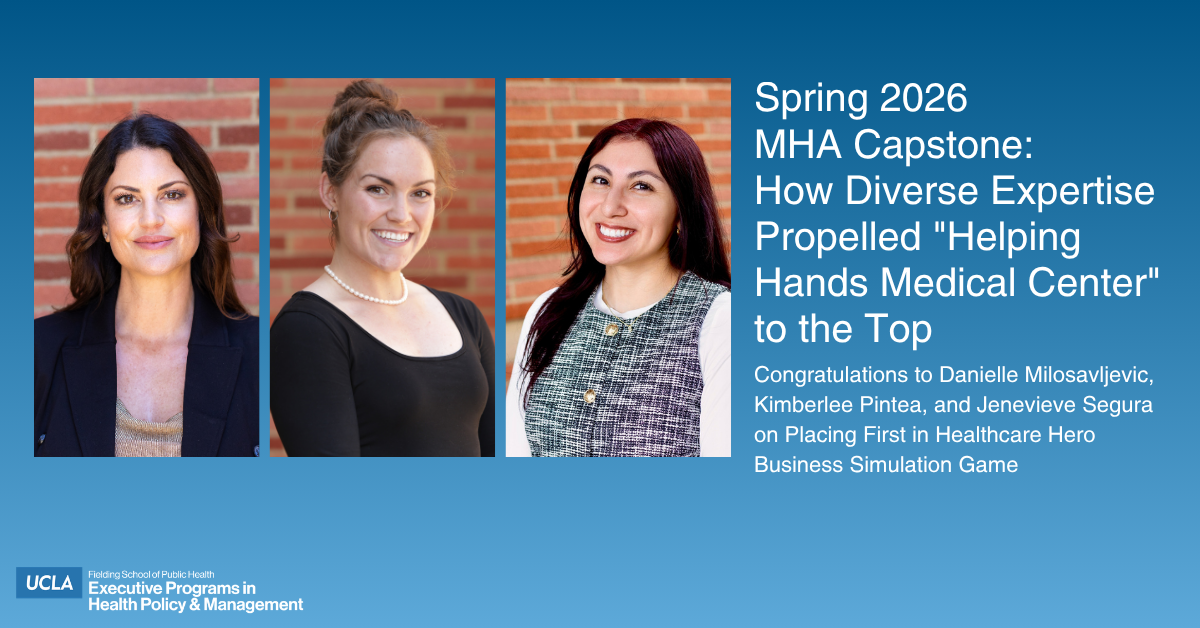
09 Jul Spring 2026 MHA Capstone: How Diverse Expertise Propelled “Helping Hands Medical Center” to the Top
With over two decades of operations leadership, critical care nursing, and patient advocacy, three UCLA MHA students, Danielle Milosavljevic, Kimberlee Pintea, and Jenevieve Segura, prove that psychological safety and laser-focused strategy are the ultimate formulas for healthcare leadership.
This Spring 2026 quarter, the UCLA Fielding School of Public Health debuted an innovative new approach to its Master of Healthcare Administration (MHA) capstone project. Moving away from traditional written theses, students were challenged to compete in “Healthcare Hero,” an immersive, high-stakes hospital management simulation.
Over the course of the quarter, teams of students assumed executive leadership roles to run competing fictional hospitals. The simulation spans eight quarters (two business years) of operations, forcing teams to navigate dynamic market shifts, unexpected economic downturns, and complex healthcare crises. Each of the eight live rounds requires analysis, decision-making, and decision submission via the simulation portal, considering strategy, pricing, quality, capacity, finance, and human resources. Designed to mirror the real-world volatility of the healthcare sector, this simulation serves as the ultimate MHA capstone because it brings classroom theory into high-level, systems-wide strategic execution.
Out of a field of fierce competitors, Helping Hands Medical Center (HHMC) was the winning team. The secret to HHMC’s victory lay in the diverse, real-world professional backgrounds each executive brought to the leadership table:
Danielle Milosavljevic (CEO): An operations professional with more than 20 years of leadership experience in business management, workflow optimization, and team development, Danielle completed the capstone in her final quarter at UCLA and participated in UCLA Fielding Commencement in June. She was inducted into the Delta Omega Honorary Society and brought a seasoned executive presence to the team.
Kimberlee Pintea (CFO): While Kimberlee was in the MHA program, she was working as a Health Facilities Evaluator Nurse with the Los Angeles County Department of Public Health. With a background in critical care nursing and healthcare regulation, she brought her sharp analytical skills, risk management expertise, and data-driven calm under pressure. Like Danielle, Kimberlee completed the MHA capstone in Spring Quarter, graduated in June, and has since moved overseas to work as a Research Nurse in the Clinical Trials Unit at Health New Zealand’s Blood and Cancer Centre.
Jenevieve Segura (COO): A Patient Advocate within Nursing Administration at Arrowhead Regional Medical Center, Jenevieve brought a vital frontline perspective, ensuring that compassionate, equitable, and patient-centered care remained at the heart of every operational decision.
We sat down with the winning team to learn how they combined their unique strengths to master the Healthcare Hero simulation.
Your team brought a mix of expertise to the table. How did you blend these distinct perspectives to build the winning strategy for Helping Hands Medical Center?
Jenevieve Segura (COO):
“Once Danielle, Kimberlee, and I met and started talking about our different backgrounds and choosing our roles, the concept became clear. Combining all of our experiences guided us to pick a name for our hospital that aligned with our values, which was to deliver exceptional care and make the patient the priority. Once we started working together and getting more comfortable within our roles, our workflows started to correlate. Our priority was to ensure we delivered quality care. We adjusted categories when necessary while collectively making sure we stayed true to our mission statement.”
The simulation is designed to throw unexpected economic and healthcare crises at you. What was the most challenging event that HHMC faced, and how did your team pivot to handle it?
Kimberlee Pintea (CFO):
“As the CFO, I came to every meeting with two general plans: one more conservative and one more aggressive. Prior to each team meeting and Synapse Café, I prepared average, best, and worst-case scenario forecasting. From there, I provided a balance of supportive and cautionary input to give space for the COO and CEO to make their decisions. When unexpected events occurred, we were able to stay calm and optimize/amplify an aggressive strategy, instead of scrambling.”
Managing a hospital at a systems level is vastly different from day-to-day operations. What was the biggest takeaway you learned about hospital management through the platform?
Danielle Milosavljevic (CEO):
“Managing a hospital at a systems level begins with a clear and well-defined strategy. Starting with the end in mind allowed me, as CEO, to establish a long-term strategic vision for Helping Hands Medical Center. A central priority was building sustainable financial stability.
Once this strategic vision was defined, it provided a clear framework for decision-making and made it easier to identify the actions needed to move HHMC in the right direction.”
How will you take the insights from this simulation into your current and future leadership roles?
Danielle Milosavljevic (CEO):
“Our success came from collaborating in a psychologically safe environment where each of us was committed to doing our best. We quickly set a clear expectation that we would support one another, avoid blame, and contribute fully, which built confidence. Another factor was our commitment to staying ahead of deadlines—we consistently submitted decisions a few days early, giving us time to refine our work. Going forward, I will carry forward the lesson that strong teams are built on trust and psychological safety.
Kimberlee Pintea (CFO):
“My biggest insights are to commit to your strategy and monitor your competitors and environment. Fully committing to a strategy or set of values can take a team much further than trying to improve everything at once. It also prevents teams from diluting their talent, resources, and momentum.”
Jenevieve Segura (COO):
“In my current role as a Patient Advocate, I am essentially the person of contact when a patient is trying to reach leadership. After completing this simulation, I realized it is essential to have a strong team behind you. Pursuing a career in healthcare administration has shown me that no matter how many years of experience one may have, teamwork and communication are essential in creating opportunities, reaching goals, and delivering exceptional patient care.”