


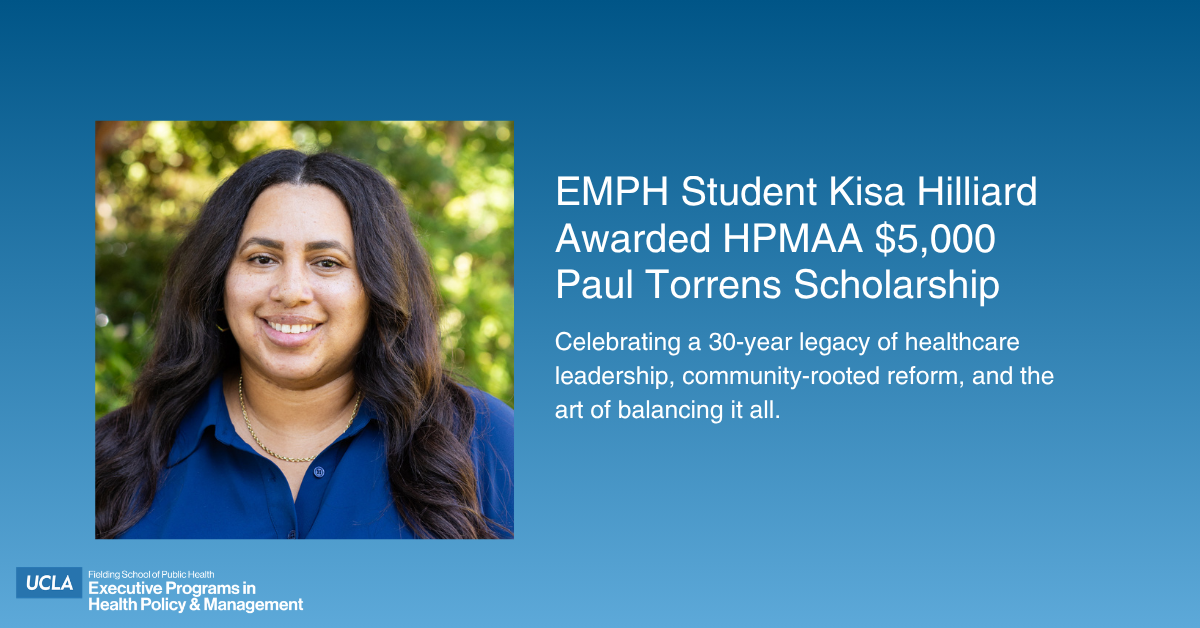
07 Jul EMPH Student Kisa Hilliard Awarded HPMAA’s $5,000 Paul Torrens Scholarship
The Executive MPH (EMPH) Program is incredibly proud to celebrate first-year student Kisa Hilliard, who was recently awarded the $5,000 Paul Torrens Scholarship. Sponsored annually by the UCLA Health Policy and Management Alumni Association (HPMAA), this initiative holds a deeply special meaning for us, as Dr. Paul Torrens founded the EMPH program exactly 30 years ago. A pioneering physician, health policy expert, and beloved UCLA Fielding mentor, Dr. Torrens dedicated his legendary career to bridging the academic and practice worlds. In alignment with HPMAA’s mission to build healthy futures by empowering healthcare leaders, this scholarship recognizes students who mirror Dr. Torrens’ lifelong commitment to ensuring the next generation of changemakers has the tools to make meaningful public health contributions, and we are thrilled to see Kisa recognized for her outstanding dedication to turning public health evidence into real-world impact.
Kisa, who just wrapped up her first year in the program while balancing a 12-year career at UCLA Health and raising a young family, embodies this spirit. On track to graduate in June 2027, she pairs an analytical background in environmental science with a lived commitment to health equity for aging and underserved populations.
Below, Kisa shares her reflections on receiving this prestigious honor, how she navigates her busy horizons, and what she is most looking forward to as she launches her upcoming summer consulting project and collaborative cohort business plan.
Throughout his career, Dr. Paul Torrens was committed to bridging the academic and practice worlds and helped create a community of people who care deeply about health. What does receiving this prestigious honor mean to you, and how do you hope to carry forward Dr. Torrens’ legacy in your own career?
Receiving the Paul Torrens Scholarship is deeply meaningful to me. Learning about Dr. Torrens’ life and work, I realized that his legacy was built on a powerful truth: healthcare systems don’t transform because we have more information; they transform when we build the structures that allow knowledge to move, to be trusted, and to be used. He spent his career creating those bridges between what we know and what we actually do. To be recognized in his name feels like an affirmation of the work I care about most: connecting ideas to impact, and ensuring that evidence doesn’t stay confined to classrooms, reports, or policy memos, but moves into practice in ways that genuinely serve communities.
I hope to carry his legacy forward by staying rooted in both rigor and compassion. My goal is to help shape systems where evidence is accessible, where collaboration is the norm, and where communities feel the impact of thoughtful policy. This honor strengthens my commitment to leading in ways that are grounded, practical, and centered on people.
What inspired you to pursue your MPH in Health Policy and Management, and as a working professional with a family, what has completing this first year meant to you?
My path to the MPH really began in 2020, when the pandemic exposed how deeply policy and systems shape people’s lives. I saw the inequities in real time as hospitals were overwhelmed, guidance appeared inconsistent, and underserved communities were again disproportionately impacted. While volunteering in the neighborhoods where I grew up, I realized that behind every breakdown was a policy decision or a missing framework. That period shifted my focus to the systems that determine whether care is accessible, coordinated, and equitable.
Over the years, my work at the UCLA Borun Center showed me how powerful thoughtful policy and strong infrastructure can be. I learned how research informs decisions, how stakeholders shape implementation, and how programs evolve when evidence is taken seriously. Pursuing an MPH felt like the natural next step.
Completing the first year while working full-time and raising a family has been both challenging and deeply rewarding. It required discipline, flexibility, and a lot of support both at home and at work. It also reminded me that growth can happen even in busy seasons. This year affirmed that I can stretch myself academically and professionally without losing sight of the people and responsibilities that matter most.
You have a bachelor’s in environmental science, over 12 years’ experience at the U.S. Department of Veterans Affairs and UCLA Health, and one year in the EMPH. As you dive into your EMPH summer consulting project, how do you plan to leverage your experience in this project?
My background and professional path gives me a perspective that feels both wide and grounded. Environmental science taught me to think about human impact—how people shape their surroundings and how those surroundings shape them back. Working at UCLA and the VA showed me how large health systems operate, where they excel, and where people may fall through the cracks. Additionally, coming from and volunteering in communities that are often asked to navigate systems that weren’t built with them in mind provided me a lived experience that keeps me honest about what solutions will actually work.
As I begin the summer consulting project, I plan to bring all of that with me: the analytical training, the operational experience, and the community-rooted intuition. It’s a combination that I believe helps me see both the big picture and the human realities within it, and I hope to use that perspective to produce work that is impactful.
With your first year behind you, you are officially on schedule to graduate in June 2027! Looking ahead, you have some major milestones on the horizon, including collaborating with your cohort on a business plan in the new year. What are you most anticipating about these final milestones, and how is the EMPH program shaping your long-term vision for driving equitable, evidence-driven health reforms?
What I’m looking forward to most in the coming milestones is the chance to build something alongside my cohort. This past year has allowed us to learn from one another’s diverse backgrounds in research, clinical care, administration, community work, and operations. The business plan project feels like the point where those strengths intersect. I’m excited for the creativity and the problem-solving that emerge when a team brings varied expertise to a shared vision.
As graduation gets closer, I’m also becoming clearer about the kind of work I want to do long term. The EMPH program has pushed me to think more strategically, to ask better questions, and to approach challenges with curiosity rather than urgency. It’s helping me refine my voice as a leader while showing me the value of making space for someone else’s strengths. I’m looking forward to carrying those lessons into roles where I can contribute and grow in ways I haven’t yet imagined.
Anything else you’d like to share?
I’m deeply grateful for the people who have supported me this year. Community has always been central to who I am, but it takes on an entirely different meaning when you’re balancing work, school, and parenting. The encouragement and care I’ve received have made this experience both sustainable and special. I’m also profoundly thankful to the HPMAA for recognizing my potential and choosing to invest in my growth through this scholarship. Thank you!