


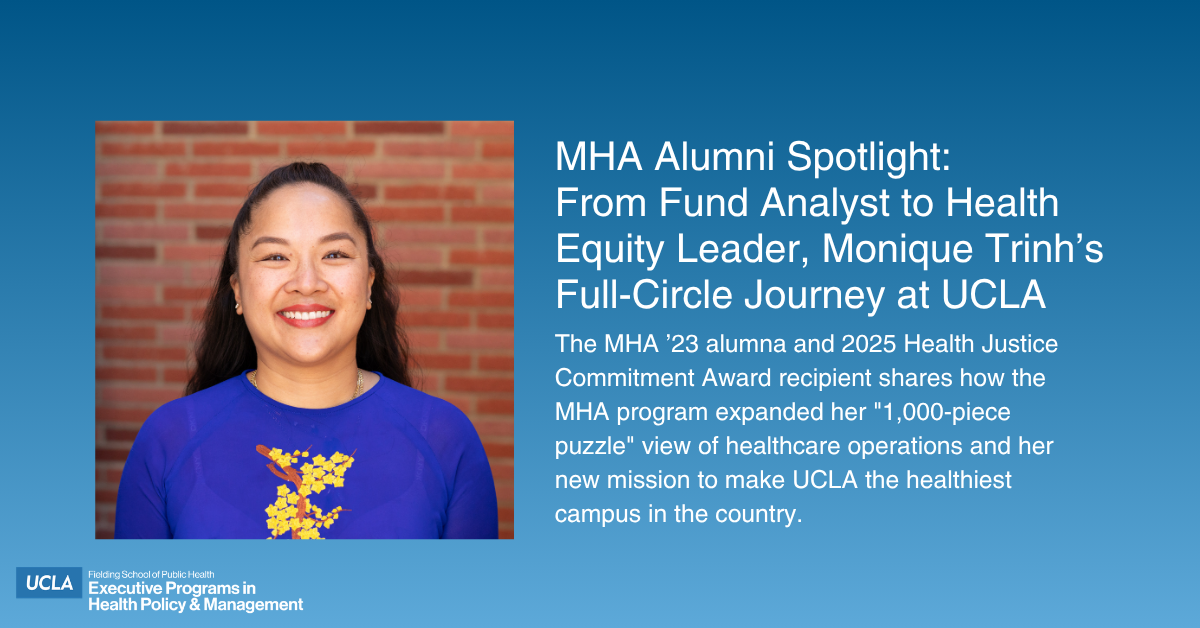
27 Apr MHA Alumni Spotlight: From Fund Analyst to Health Equity Leader, Monique Trinh’s Full-Circle Journey at UCLA
For Monique Trinh, MHA (UCLA Class of ’23), the path to leadership has been paved with a deep commitment to the UCLA community she has served for over 15 years. A first-generation professional and the child of Vietnamese immigrants, Monique recently transitioned from a decade-long tenure at the UCLA David Geffen School of Medicine to become the Operations and Budget Manager for the UCLA Semel Healthy Campus Initiatives (HCI) Center.
Monique’s journey is a masterclass in leveraging the MHA degree to “level up” from technical financial management to strategic, human-centered leadership. From receiving the 2025 UCLA Health Just Action Summit Health Justice Commitment Award to her current role as an inaugural UCLA Bedari Kindness Research Fellow, Monique exemplifies how data and budgeting can be powerful tools for advocacy and equity.
In this Q&A, Monique reflects on the nature of her new role, the importance of treating LinkedIn as a reflection of growth, and why the MHA program is ultimately a journey of discovering one’s leadership voice.
Q: Tell us about your role at Semel HCI. What are you most excited to tackle in this position?
Trinh: I serve as the Operations and Budget Manager for the UCLA Semel Healthy Campus Initiatives (HCI) Center within the Chancellor’s Organization, which aims to make UCLA the healthiest campus in the country and beyond. Led by Associate Vice Provost Wendelin Slusser, the Semel HCI Center brings partners across North and South Campuses and the broader UC System together to translate research into practice and foster a collaborative approach to well-being. UCLA’s adoption of the Okanagan Charter further strengthens this work by providing a shared framework to embed health and well-being into how the university operates and evolves.
In my role, I translate strategic priorities into operational plans, strengthen financial sustainability, and build partnerships across campus and beyond. My work centers on supporting AVP Slusser’s strategic vision by creating systems that enable new ideas to take shape and grow, while embedding well-being into our day-to-day operations as a core part of how we design our work.
As a first-generation professional who has spent the past 15 years at UCLA, this role feels like a full-circle moment. As a native Angeleno, I find the work deeply personal; what happens at UCLA affects the Bruin community and the broader communities we serve, including those I am part of and care about deeply. Over time, I have built meaningful relationships and developed a nuanced understanding of how systems can both support and challenge well-being. I am grateful for the opportunity to better understand and address barriers, and to help create a more supportive, responsive, and equitable environment where our community can truly thrive.
Q: You worked at DGSOM for years as a Fund Analyst and Program Manager. How did the MHA program specifically help you “level up” your financial tool development and leadership approach?
Trinh: My time at the David Geffen School of Medicine at UCLA provided a strong technical foundation in financial management and quality improvement. The MHA program broadened my perspective, helping me see how these elements fit into the larger healthcare system. Before the program, I viewed operations as a 100-piece puzzle; the MHA expanded that view into something much bigger, more like a 1,000-piece puzzle, clarifying how finance, policy, operations, and people are interconnected.
I began to see financial tools not just as a way to report on performance, but as a way to support better decisions and align resources with what matters most. I also developed a broader systems lens that continues to guide my approach to collaboration and decision-making. More importantly, it shifted how I think about budgeting. I now see budgets as one of the clearest reflections of priorities, and data as a powerful tool for advocating for vulnerable, marginalized, and underserved communities and for supporting sustained investment in community benefit and the public good.
One significant milestone for me was receiving the 2025 UCLA Health Just Action Summit Health Justice Commitment Award. That experience affirmed that the leadership perspective and equity frameworks I strengthened during the program were translating into real impact in my work. Receiving that recognition on April 30, 2025, also held personal meaning for me as the child of Vietnamese immigrants, grounding my work in the sacrifices that made opportunities like this possible.
It also reinforced how I approach leadership, especially in balancing what is right for the person receiving care with what is right for those providing that care, while ensuring solutions remain ethical, sustainable, and human-centered.
Q: How has the UCLA Fielding and HPM network supported your career growth, and what is your best piece of advice for students considering getting involved with HPMSA?
Trinh: The UCLA Fielding School of Public Health (FSPH) and the Health Policy & Management (HPM) network have been central to my growth. This community values collaboration, mentorship, and shared learning, creating meaningful opportunities to connect with people across different parts of healthcare.
What stands out most is the genuine willingness of people to invest in one another. Since graduating in 2023, I have made it a priority to stay engaged by attending and supporting events, both in person and virtually. I especially look forward to connecting with Dr. Erskine, Gigi, Jenna, Kyle, and Sarah during each MHA Immersion. Their continued guidance and support, both during and after the program, have been one of the greatest gifts of the MHA experience.
That sense of connection has deepened through my involvement with the Health Policy & Management Alumni Association (HPMAA), where I have had the opportunity to both learn from and contribute to the network more intentionally. This includes mentoring students and supporting others as they navigate their own paths, which has become one of the most impactful and grounding ways I remain connected to the program and continue learning alongside others. I am also grateful to be able to reach out to my professors for insight or to share ideas. These relationships have provided guidance, perspective, and support throughout my journey, and as a first-generation student and professional, they have helped shape the leader I hoped to become and have given me the courage to navigate resistance and recognize it as a sign that meaningful change is underway.
My advice to students is to engage early and be intentional about building relationships. Take advantage of Synapse Café, office hours, programming, and student organizations while you have the privilege and access. The MHA Student Association (MHASA), Health Policy & Management Student Association (HPMSA), and the broader network are communities, not just resources. The more you show up, ask questions, and stay curious, the more meaningful those connections will become.
Q: Looking back to when you started your MHA, what is one thing you know now about the MHA journey that you wish you knew then?
Trinh: Looking back, I realize the MHA program is as much about personal and leadership growth as it is about academic learning.
When I began the program, I focused on building skills and learning new concepts. What I did not fully appreciate at the time was how much the experience would shape my thinking, communication, and approach to complex challenges.
I wish I had trusted the process more. While the workload can feel intense, it is intentionally designed to build your capacity to manage competing priorities and navigate uncertainty, which are essential to healthcare leadership.
I also wish I had given myself more space to pause and be present in the experience. The program moves quickly, and in the moment, it can feel like you are always looking ahead, but some of the most meaningful growth happens when you slow down enough to take it in.
What surprised me most was how much the program helped me find my healthcare community. Being surrounded by people who deeply understand healthcare and public health, and who share similar values and challenges, has been one of the most meaningful and lasting parts of the experience. These relationships have become my support system and thought partners, and have even led me to my Bruin besties, Chris, Christina, and Racquel, who continue to ground me and remind me why this work matters, both personally and professionally, beyond the program.
Q: Our students are eager to learn how to promote themselves. What is your #1 tip for an MHA student’s LinkedIn profile?
Trinh: I would encourage students to think of LinkedIn as a platform for reflecting on their growth, not just to document their experience.
Share what you support, what you are learning, what interests you, and how you apply that knowledge. Engage with people and organizations that align with your interests and be intentional about building relationships and bridging connections across communities, disciplines, and perspectives. Be bold and take initiative by reaching out, asking for informational interviews, and starting conversations.
LinkedIn is less about self-promotion and more about demonstrating how you think, learn, and evolve as a professional, while building relationships and learning alongside others. Some of the most transformative opportunities emerge from the relationships you build along the way.
Q: Is there anything else you wish to share?
Trinh: One thing I would share is that the UCLA FSPH MHA program reinforced for me that advancing health equity is not just something we talk about; it is something we have to build into how we lead and how we work every day.
Through the program, I learned to approach my work through a human-centered, restorative lens, making relationships, trust, and well-being central to how I design solutions. It also strengthened my belief that intentionally investing in both systems and relationships is essential to creating meaningful, lasting change.
This perspective continues to guide my leadership. I am committed to creating environments where individuals feel supported, valued, and able to contribute at their highest level, while thoughtfully shaping systems that reflect those same values.
I would encourage you to stay grounded in your values, be an informed skeptic, and lead with kindness. Each of us has a role to play in leveraging our influence to thoughtfully shape systems to be more equitable and responsive to the communities they serve. Approach your work with an equity lens, meeting people where they are and co-creating solutions shaped by their needs and lived experiences.
Stay humble and curious, recognizing that there is often more than one way to move forward. Champion community resilience and psychological safety and remember that health and well-being are shaped everywhere. You may not always get it right, but you can always make it right.
I am also mindful of where I come from and deeply grateful for those who have supported and sustained me along the way. Healthcare and public health are collective efforts, and this work is never done alone.
I continue to deepen this commitment as an inaugural UCLA Bedari Kindness Research Fellow, where I am learning to lead with intention, empathy, and care within complex systems, and to show up in ways that make systems better for the people they serve.