


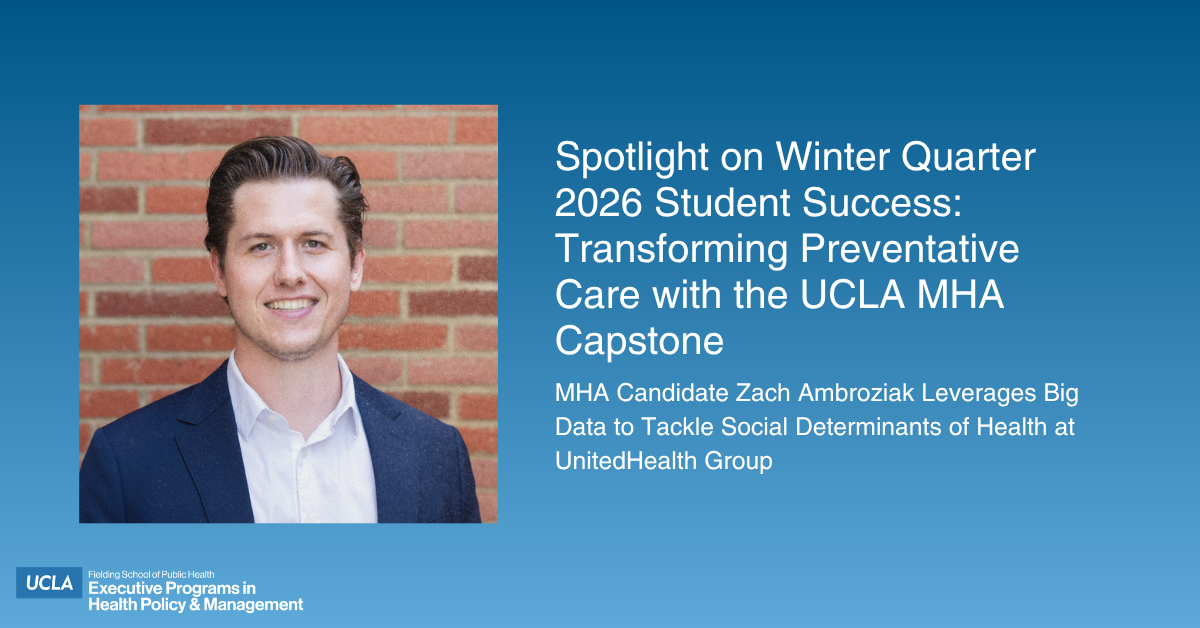
02 Apr MHA Candidate Zach Ambroziak Leverages Big Data to Tackle Social Determinants of Health at UnitedHealth Group
The UCLA Master of Healthcare Administration (MHA) program is designed to empower students to look beyond their day-to-day responsibilities and solve the industry’s most complex financial and clinical challenges.
Zach Ambroziak used his UCLA MHA capstone to drive innovation at UnitedHealth Group, utilizing claims data to analyze the impact of Social Determinants of Health (SDOH) on medical expenditure. By shifting the focus from reactive treatment to upstream preventative measures, Zach’s research offers a data-driven roadmap for improving member health while optimizing constrained resources. Under the guidance of Professor Seth Lake, Zach successfully synthesized economics, finance, and leadership to break down professional silos and create a tool that is already delivering value across multiple markets.
We sat down with Zach to discuss his findings, his collaborative approach, and how the MHA program has solidified his path as a leader in healthcare economics.
Without revealing confidential data, can you give us a high-level overview of your capstone project and the problem you sought to solve?
Zach: My project focused on using claims data from our health plan’s beneficiaries to analyze the clinical and financial impact that shortcomings in Social Determinants of Health (SDOH) were having. The problem that I was trying to solve was that overall medical expenditure in our plan and the wider healthcare industry is increasing despite clinical outcomes lagging behind. Rather than practicing reactive care, by responding to and paying for diseases after they have already developed in our members, I wanted to propose a more upstream approach by targeting SDOH factors and enacting preventative measures to prevent disease development down the road. Because we’re working with constrained resources in the form of a limited budget, I used statistical analysis to determine which SDOH factors would have the greatest impact on improving the health of our members and reducing overall medical costs for the health plan.
What is the single most important lesson you learned through this experience?
Zach: The most important lesson that I learned throughout this process is to always remain curious. While the capstone experience gave me an excuse to start looking beyond my day-to-day responsibilities and dig further into the resources around me, this project is something that I could have done at any point in my tenure at UHC. Sometimes it can be easy to fall into a routine of working only on what you are supposed to, when we have the ability to go above and beyond our job descriptions. After completing my capstone and seeing how my work is already being used to benefit other states and markets, I’ve become motivated to investigate other ways we can utilize the massive amount of data and tools at our disposal to benefit our members beyond our standard daily responsibilities.
What is something you discovered or mastered during this project that you are already applying (or plan to apply) in your role at UnitedHealth Group or in your future work?
Zach: Because SDOH data is not something that I typically work with, I found myself collaborating closely with other colleagues and experts in teams outside my own that had more experience with it. I realized how little I find myself aligning with others outside my direct silo, and this collaboration helped enable the creation of an analysis and a dashboard that benefits the entire department. While collaboration itself is not a new concept to me, I discovered how effective it can be to reach out to others who are more experienced and have greater knowledge of areas in which I am not familiar. If I am to become a successful leader in the healthcare industry, I will no doubt need to leverage the skills and knowledge of those around me as I did in this capstone experience.
How did the capstone help you synthesize the different disciplines—like economics, finance, and leadership—that you studied throughout the program?
Zach: One of the main reasons that I chose the UCLA MHA program over other programs was that every single class in the curriculum was relevant to my current professional work as well as the work that I hope to perform in the future. I employed statistical analysis, built Excel models, investigated public health and SDOH factors, navigated relationships with different teams and executive leaders, and engaged in many other activities in which I drew upon what I’ve learned thus far in my MHA journey. The capstone was an excellent representation of applying what we’ve learned in class to the real world, and it also gave me a good look into the type of work that I hope to do in the future as a leader in the healthcare industry.
Is there anything else you’d like to share about your experience working with Professor Lake or the MHA program in general?
Zach: Professor Lake was an excellent guide throughout this experience, and I appreciate both his advice and his patience with the handful of delays that I experienced throughout the process. The capstone was something that I had looked forward to since my first quarter in the program, and it provided an excellent excuse to step back and think about how I’ve developed in my academic, professional, and personal life from the start of the MHA program until now. As I finish up the last few classes before graduation, it’s become clear that this program was the right choice for me and is already helping me achieve the career that I had envisioned.