


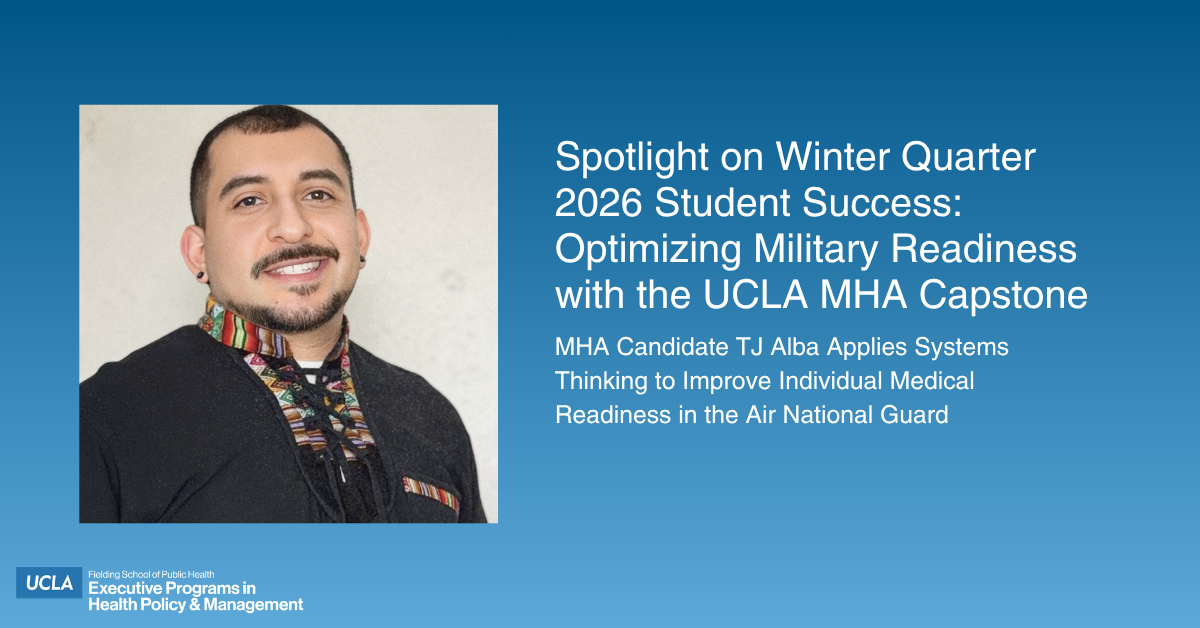
03 Apr MHA Candidate TJ Alba Applies Systems Thinking to Improve Individual Medical Readiness in the Air National Guard
Photography | Eric Rodriguez
The UCLA Master of Healthcare Administration (MHA) program attracts leaders from diverse professional landscapes, proving that the principles of high-level operations and systems thinking are universally applicable. TJ Alba used his UCLA MHA capstone to address complex barriers to Individual Medical Readiness (IMR) compliance within a geographically distributed Air National Guard organization. By leveraging his extensive background in emergency management and his current role as a defense contractor at SAIC, TJ shifted the analytical focus from “people problems” to “system problems,” mapping workflows to identify friction points in resource-constrained environments.
Despite the unique challenges of supporting international military operations and attending “Synapse Café” sessions at 2:00 AM from overseas, TJ successfully integrated MHA disciplines—such as process improvement and organizational analysis—to produce high-impact outcomes outside of a traditional clinical setting. Under the mentorship of Professor Seth Lake, TJ translated military crisis response strategies into a practical healthcare framework that ensures service members are mission-ready.
We sat down with TJ to discuss his dual perspective as an Airman and a defense contractor, and how the MHA program has sharpened his ability to lead across complex, mission-critical environments.
Without revealing anything sensitive or confidential, can you give us a high-level overview of your capstone project and the specific problem you addressed?
TJ: My capstone project focused on improving Individual Medical Readiness (IMR) within an Air National Guard organization with a non-traditional structure. This organization relies on multiple external medical units to support a mostly part-time force distributed over a wide geographic area.
What is the most important lesson you learned through this experience?
TJ: The most important lesson I learned is that performance problems are often system problems, not people problems. While this was a recurring theme of the MHA program’s case studies and lectures, the capstone project allowed me to witness and address this concept in a real-world setting.
How did your extensive background in the Air National Guard and Emergency Management influence your approach to solving a healthcare administration challenge?
TJ: I have served in the Air National Guard as an Emergency Management Specialist in both full-time and part-time roles since 2014, working on a variety of mission sets. Currently, I am a part-time Airman and work full-time for Science Applications International Corporation (SAIC) as a defense contractor, where I support United States crisis response capabilities and integration with allies in Europe. This dual perspective as both a part-time Airman and a full-time defense contractor directly influenced my approach to the project.
In emergency management, success depends on coordination across various organizations, clearly defined responsibilities, and the ability to operate within real-world constraints. I applied that same mindset to this healthcare-focused problem by mapping workflows, identifying friction points, and focusing on solutions that would be realistic in a distributed, resource-constrained environment. Being a part-time Airman also gave me a deeper understanding of the time and access limitations that many service members face, which helped keep my recommendations practical.
In what ways has the MHA program enhanced your ability to support mission-critical work in your role at SAIC?
TJ: Although my role at SAIC is not within the healthcare industry, the MHA program significantly strengthened my ability to analyze complex systems and develop actionable solutions. In my day-to-day at SAIC, I help develop relationships among numerous stakeholders, analyze past military missions and exercises to identify lessons learned and best practices, and facilitate frameworks for multiple nations to work together in times of crisis.
The concepts I learned throughout the program like process improvement, systems thinking, stakeholder engagement, and organizational analysis are not limited to healthcare. Through both my coursework and the capstone project, I have been able to apply these concepts outside of a traditional healthcare setting and still produce meaningful, high-impact outcomes. This experience reinforced that strong administrative and operational frameworks can be adapted across industries to solve complex problems.
How did the capstone help you integrate the different disciplines—such as operations, leadership, and policy—that you studied throughout the program?
TJ: The capstone project allowed me to bring together the different concepts I learned throughout the MHA program and apply them to a real-world problem from an operational, leadership, and systems-based perspective.
From an operations standpoint, I analyzed workflows and identified bottlenecks. From a leadership perspective, I incorporated input from senior leaders to ensure my recommendations were both realistic and aligned with mission priorities. From a systems perspective, I worked within existing constraints rather than proposing ideal but impractical solutions. This integration of concepts mirrored how problems are solved in military crisis environments, where success depends on balancing strategy, execution, and feasibility.
Is there anything else you’d like to share about your experience working with Professor Lake or navigating the program as a military professional?
TJ: Working with Professor Lake was extremely valuable; he emphasized applying concepts in a way that translates beyond the classroom. His guidance helped ensure my project remained practical and focused, while also making sure my work was understandable to faculty and staff without a military background.
As a part-time service member working full-time in support of military operations, the MHA program has been both challenging and rewarding. There were numerous times when real-world operations took precedence over my coursework, but the program’s flexible, asynchronous format allowed me the time and space to succeed. Living overseas and attending the Synapse Café sessions at 2:00 AM was certainly a struggle, but it was well worth it as I approach graduation. The capstone experience was an intense 10-week period, but it enabled me to directly apply my learning to a real operational problem. It also demonstrated that even without a traditional healthcare background, the principles of healthcare administration can be effectively applied in complex environments to produce meaningful results.