


01 Apr UCLA Online MHA Capstone Projects Spring 2025
Congratulations to all of the MHA students who just completed their capstone project during Term 7 of the program.
In this applied field project, taught by Professor Seth Lake, MPH, the assignment in the UCLA online MHA program is to design and conduct a project based on a health administration problem addressing the delivery, financing and evaluation of healthcare administration services. Students prepare a consulting report and presentation for a letter grade.
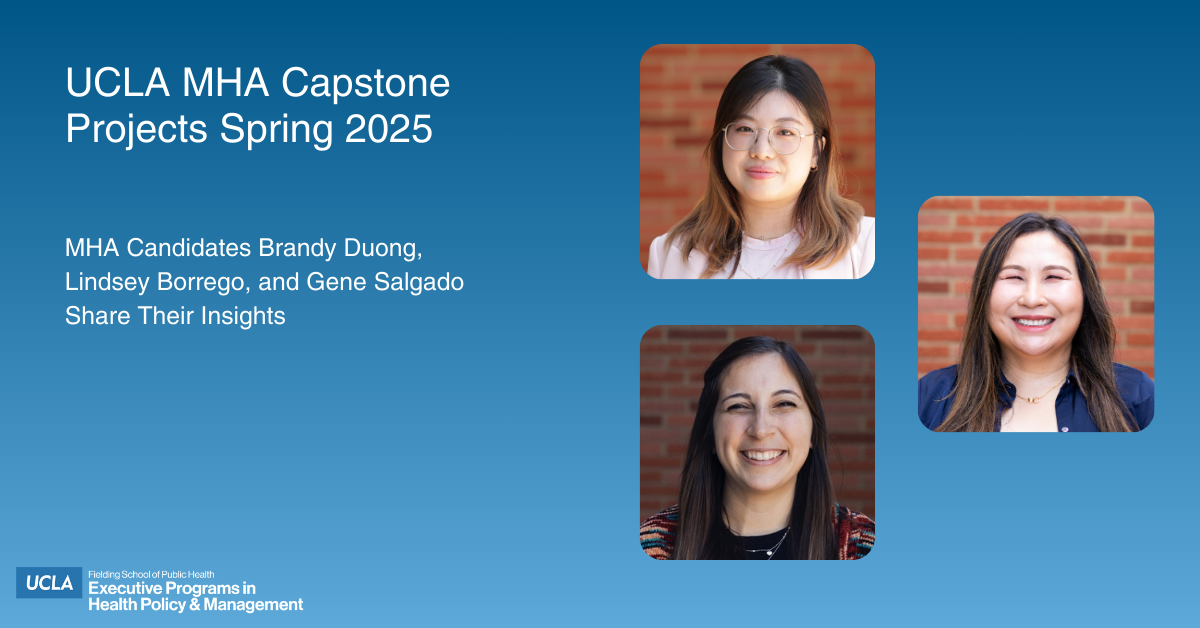
We caught up with three students who Professor Seth Lake said did a fantastic job on their UCLA online MHA consulting projects this Spring 2025 quarter, to learn about their experience.
Brandy Duong, UCLA Fielding School of Public Health MHA Candidate
Tell us about your UCLA online MHA capstone project:
My capstone project was about improving access to in-network durable medical equipment (DME) to promote patient access to care. From a payer’s perspective, the goal in my Provider Contracting department is to fulfill network adequacy and ensure that all gaps in patient care and services are reduced. My main objective in my capstone project focuses on expanding DME services in my organization’s network while reducing the use of out-of-network vendors. This helps reduce costs and delays of care.
What is a key takeaway you have about the experience?
My key takeaway from my capstone experience was that it was crucial to have a preceptor with access to the data I needed to complete my research. Finding the right data for such a large-scale project is difficult without proper support from your preceptor. The success of my project was due to having the right guidance and support from my preceptor. As such, I would recommend my peers to continuously communicate with your preceptor on a regular basis about your project so they can help guide and provide you with the right tools to succeed.
Lindsey Borrego, UCLA Fielding School of Public Health MHA Candidate
Tell us about your UCLA online MHA capstone project:
My capstone project examined the relationship between philanthropy staff and clinical/administrative staff at an organization, ultimately providing tactics that the organization can use to foster this crucial relationship. I appreciated how I was able to tailor my project to strengthen my expertise in healthcare philanthropy, a topic I am deeply passionate about.
What is a key takeaway you have about the experience?
A key takeaway is that I have the knowledge and tools to confidently evaluate a real-world problem and provide tangible, data-driven solutions to address it. This project has allowed me to foster my critical thinking, problem-solving, and research skills, all of which are necessary to ensure I am a successful leader in my profession.
Anything else you’d like to share?
Overall, I had a great experience and enjoyed having the opportunity to work with several talented individuals whom I may not have ever worked with in this capacity otherwise. Because of this class, my professional network is larger and my existing relationships with certain professionals in this industry are much deeper.
Gene Selgado, UCLA Fielding School of Public Health MHA Candidate
Tell us about your UCLA online MHA capstone project:
My capstone project focuses on reducing inappropriate emergency department (ED) utilization among high utilizers. ED visits are a high-intensity service and high-cost drain on the health care system and patients. Specific ED incidents may be attributed to avoidable or treatable conditions.
What is a key takeaway you have about the experience?
Extensive research from credible sources is important to find out the underlying cause of the issue. High Emergency Department (ED) utilization rates are a common issue in every managed care or health insurance plan. The importance of a project like this is not just to educate the patients on how to utilize resources available for them to navigate the healthcare system, as ED visits are very costly and can hurt the healthcare organization budget that could have been more allocated to other programs that will be beneficial to the patients. In the process, I’ve learned that motivational interviewing, patient teaching, and addressing the social determinants of health are essential. These are the keys to reducing inappropriate ED visits and improving patient outcomes. It is crucial to reduce the burden on the ED and to motivate and commit to improving patient outcomes.
Anything else you’d like to share?
Both Dr. Laura Erskine and Professor Seth Lake are awesome. I had Professor Lake last quarter for my capstone project. I appreciate that he answered questions about the project deliverables during Synapse cafes. My recommendation to the students is to follow the rubric, schedule your 1:1 with the professor early on so you can discuss your capstone project and receive feedback, and send your draft to your preceptor at least one week before the project due date to give them ample time to review your project and provide feedback if needed.